

Food contact safety documents for PET bottles trip up many buyers. One missing page can stall customs, and worse, hide a risk. Our Taizhou team learned this the hard way.
The food contact safety documents to request are a signed Declaration of Compliance for the finished bottle, migration testing results covering overall and specific limits, a batch-tied Certificate of Analysis, resin food-grade statements, additive and colorant disclosures, GMP evidence, and, for rPET, an approved recycling-process certificate.
That list looks long. It is. But each document closes a specific gap. Below, I walk through what to verify, what the test reports should show, how the US, EU, and Australia differ, and what to do when a supplier cannot deliver the full pack.
What Certifications Should I Verify Before Signing Off on a PET Bottle Supplier?
During a QC audit in our Taizhou plant, a German buyer flipped past our bottle spec sheet and asked one question: which certificate covers the cap liner?
Verify a Declaration of Compliance citing EU Regulation 1935/2004 and 10/2011, an FDA statement referencing 21 CFR 177.1630, Good Manufacturing Practice evidence under Regulation 2023/2006, third-party lab certificates from bodies like SGS or Intertek, and upstream resin certifications from the virgin resin producer.
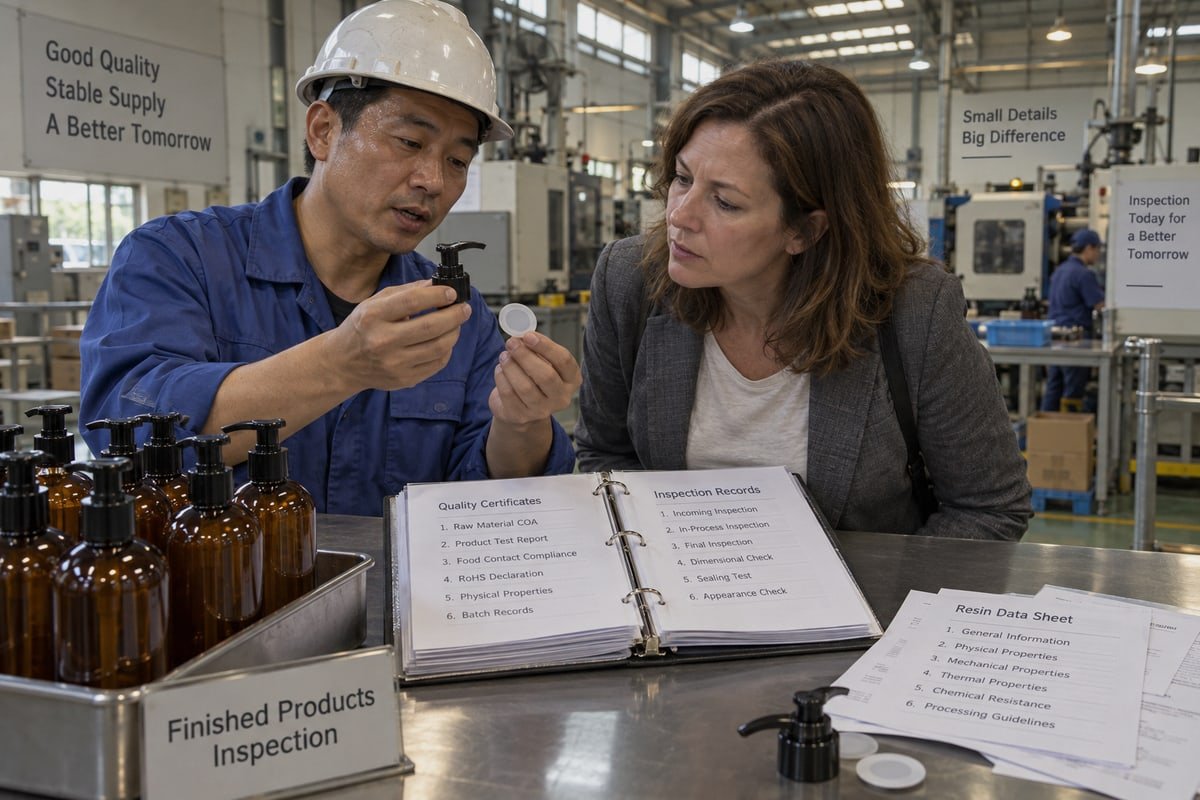
That question about the cap liner stuck with me. It exposed the core problem with the phrase "food grade." A resin can be food grade. A bottle can still fail. The closure, the colorant, the label adhesive, and any barrier layer are all part of the food contact material 1 once assembled. So the certifications you verify need to cover the finished article, not just the pellets that went into it.
The core certification set
Here is how I lay out the pack for our buyers in the United States, Germany, and Australia. We make mostly cosmetic and skincare packaging, but brand owners running wellness and beauty lines side by side now expect the same rigor on every PET bottle.
| Document | What it must cover | Who issues it | Red flag |
|---|---|---|---|
| Declaration of Compliance | Finished bottle, closure, colorant, decoration; intended use conditions; references to EU 1935/2004 and EU Regulation 10/2011 | Bottle converter, signed | Covers resin only, no use conditions stated |
| FDA food grade certification statement | Confirmation the PET resin and additives fall under 21 CFR 177.1630 | Resin producer and converter | Generic "FDA approved" wording with no CFR citation |
| Good Manufacturing Practice evidence | Contamination control, traceability, change management under EU Regulation 2023/2006 | Converter, plus third-party audit if available | No traceability documentation from preform to pallet |
| Third-party lab certificate | Migration and heavy metal testing on the actual bottle | SGS, Intertek, TÜV, or similar | Test dated years ago, or done on a different SKU |
| Upstream resin certification | Resin identity, intrinsic viscosity spec, food-contact status | Virgin resin manufacturer | Converter cannot name the resin source |
Why the resin producer's paperwork matters
Some buyers push back here. They tell me PET is a mature, low-risk material with decades of approvals, so a resin statement should be enough. I understand that view, and the migration data support it for pure PET. But the objection misses where risk actually lives. In our experience, the resin is rarely the problem. The problem is undocumented variation: a colorant swapped between lots, a slip additive added to the closure, or a converter buying off-spec resin from a trader. Upstream traceability documentation is how you catch that. If your supplier cannot name the virgin resin manufacturer and show that producer's own food-contact certification, the rest of the pack rests on trust alone.
Which Migration and Extraction Test Reports Do I Need for Food-Grade PET Bottles?
Every time we quote a full migration panel, I weigh lab cost against risk. Skipping specific migration saves money upfront and can cost a whole shipment later.
Request overall migration results against the 10 mg/dm² Overall Migration Limit, specific migration results for antimony and acetaldehyde, heavy metal testing, NIAS screening where available, and confirmation that simulants, temperature, and contact time match your actual fill conditions and shelf life.

The trade-off I mentioned is real. A full panel from a recognized lab is not cheap for a small-run custom bottle. But the cost of a rejected container at a port in Hamburg or Sydney is far higher. So here is how I help buyers decide what they actually need.
Overall versus specific migration
Overall migration measures everything that leaves the plastic into a food simulant. Specific migration measures named substances against their own limits. PET needs both, because pure PET behaves very well on the overall test while a few specific substances still deserve attention.
| Test | Limit under EU Regulation 10/2011 | Typical PET bottle result | Why it matters for PET |
|---|---|---|---|
| Overall Migration Limit | 10 mg/dm² | Around 0.1 mg/dm² reported in industry data | Confirms the whole bottle, including additives, stays far below the ceiling |
| Specific Migration Limit, antimony | 0.04 mg/kg | Usually compliant, rises with heat and time | Antimony trioxide is the common PET polymerization catalyst |
| Specific Migration Limit, acetaldehyde | 6 mg/kg | Batch dependent | Acetaldehyde is a PET degradation byproduct affecting taste and odor |
| Heavy metal testing | Per Annex II of 10/2011 and Packaging Directive limits | Usually low, colorant dependent | Colorants and masterbatches are the usual source |
That 0.1 versus 10 gap is where the second buyer objection comes in. Some procurement managers tell me testing is pointless because PET always passes by a wide margin. My answer is that the margin belongs to PET, not to the tinted, barrier-coated, decorated bottle you are buying. Colorants, UV blockers, oxygen scavengers, and closure liners are not PET. They are the reason the test still matters.
How to read the report
When a report lands on my desk, I check five things before I forward it.
- Test method and lab. The report should name the standard used and the lab, ideally SGS, Intertek, TÜV, or a similar accredited body.
- Simulants. Aqueous, acidic, alcoholic, and fatty simulants behave differently. The simulant should match your product.
- Conditions. Temperature and time should reflect your fill. Hot-fill or pasteurization needs harsher conditions than ambient water.
- Sample identity. The tested sample should be your bottle, your color, your closure. Not a clear reference bottle from another project.
- Acetaldehyde data. Ask for batch-specific acetaldehyde results 2, not a generic spec range. AA is a taste and odor issue, so beverage and oral wellness brands care most.
NIAS screening, meaning a scan for non-intentionally added substances 3, is not yet standard on every PET report. But our German buyers ask for it more each year, and it is worth requesting when the bottle carries recycled content or multiple additives.
How Do I Confirm My PET Bottle Supplier's Documentation Meets US, EU, and Australian Regulations?
An Australian procurement manager once sent me three WhatsApp messages in a row: does this pack work for FSANZ, for the FDA, and for our German distributor?
Match each document to its regulation: 21 CFR 177.1630 and FDA recycled-plastics guidance for the US; Regulation 1935/2004, 10/2011, 2023/2006, and 2022/1616 for the EU; and FSANZ Standard 1.4.3 with AS 2070 for Australia, which accepts FDA or EU evidence.

Those three messages describe most of our export customers in one line. A brand in Melbourne, a distributor in Germany, and a US retail listing. Each market reads the same food contact safety documents through a different lens. So I now build one pack and then map it to all three before it leaves Taizhou.
Side-by-side regulatory map
| Requirement | United States | European Union | Australia |
|---|---|---|---|
| Core legal basis | 21 CFR 177.1630, polyethylene phthalate polymers | Regulation (EC) 1935/2004 framework plus EU Regulation 10/2011 for plastics | FSANZ Standard 1.4.3, supported by AS 2070 |
| Manufacturing controls | FDA GMP expectations under 21 CFR 174.5 | Regulation (EC) 2023/2006, Good Manufacturing Practice, mandatory | AS 2070 points to FDA or EU compliance as acceptable evidence |
| Key document | FDA food grade certification statement citing the CFR section | Signed Declaration of Compliance with use conditions and supporting migration data | DoC or FDA statement plus lab reports; distributors often request both |
| Recycled PET | Tertiary recycling 4 processes suitable for food contact are no longer individually evaluated in the same way; buyer still needs process evidence | Regulation (EU) 2022/1616, EFSA-authorized recycling process required | Follows FDA or EU proof; check the process authorization cited |
| Lot-level proof | Certificate of Analysis 5 per batch, industry expectation | Traceability required under Article 17 of 1935/2004 | Certificate of Analysis tied to the shipment |
Where the three markets diverge most
The biggest divergence is recycled content. The FDA position gives suppliers room. Suitable tertiary recycling for PCR-PET is not re-evaluated one process at a time, provided the process is appropriate for food contact use. The EU is stricter. Regulation 2022/1616 6 sets rPET safety standards that require an authorized recycling process and controlled post-consumer feedstock. A bottle that clears US review on a supplier's process description can still fail in Germany without the EFSA-linked authorization. I have seen buyers assume the looser rule travels. It does not.
The second divergence is the Declaration of Compliance itself. In the EU it is a legal document with defined content, including the intended conditions of use. In the US the equivalent is often a one-page statement. For Australia, the practical path is to hold both, because FSANZ Standard 1.4.3 is outcome based and AS 2070 leans on overseas evidence.
A quick scope check before you accept the pack
- Does the DoC name the exact bottle SKU, color code, and closure?
- Are hot-fill, long shelf life, or repeated use stated if you need them?
- Is the label, shrink sleeve, and ink system covered or excluded?
- Does the rPET section name the recycling process and its authorization?
- Is there a Certificate of Analysis for the lot on the packing list?
When all five answers are yes, the pack usually holds up in all three markets.
What Should I Do If My Supplier Can't Provide Complete Food Contact Safety Paperwork?
The hardest lesson our ten-person team took from export work was simple. A supplier who stalls on paperwork is telling you something about their traceability.
Pause the order, ask which specific document is missing and why, request lot samples for independent third-party migration testing, and add a contractual non-conformance clause assigning liability and remedy. If the supplier cannot name the resin producer or recycling process, switch suppliers.

I say this from both sides of the table. Early on, we were the supplier who could not answer a colorant question fast enough. That delay cost us a reorder. Since then we treat the compliance pack as part of the product, not an afterthought. Here is the process I now recommend to buyers when the food contact safety documents come up short.
A five-step recovery process
- Name the gap precisely. "Send everything" invites another generic spec sheet. Instead, write: "We need the specific migration result for antimony on color code X under hot-fill conditions." Precision separates a slow supplier from an unable one.
- Ask why it is missing. A new colorant not yet tested is a fixable problem. A converter who does not know the resin source is a structural problem.
- Commission your own test. Pull retained samples from the delivered lot and send them to SGS, Intertek, TÜV, or an accredited local lab. Migration testing results in hand beat promises.
- Fix the contract. Add a clause stating who pays if post-delivery testing shows non-compliance: replacement, credit, return freight, and destruction costs. Under DDP terms, spell out that the supplier's obligation covers documentation, not just delivery.
- Decide with a deadline. Give the supplier a fixed number of days. Then either approve, hold, or move on.
Which gaps are fixable and which are not
| Missing item | Likely cause | Fixable in weeks? | My recommendation |
|---|---|---|---|
| Batch Certificate of Analysis | Lab step skipped for a rush order | Yes | Require CoA before shipment release |
| Migration data on a new color | Colorant added after last test | Yes | Test at supplier's cost, hold the color until cleared |
| Good Manufacturing Practice evidence | No documented system | Partially | Audit, or require third-party audit within a set period |
| Resin producer traceability | Resin bought from traders | Rarely | Switch supplier or accept only virgin resin with documented source |
| rPET process authorization | Uncontrolled feedstock | No, for EU | Do not use that rPET in EU-bound bottles |
The theme across that table is that documentation problems and quality problems tend to travel together. A supplier who cannot trace the resin also struggles to trace why a lot leaked or warped. Paperwork discipline and QC discipline are the same discipline. That is why I tell buyers to treat a thin compliance pack as an early warning, not a clerical annoyance.
Conclusion
Do not settle for a food grade label. Request the full compliance pack, tie it to your lot, and let the paperwork prove the bottle. Questions? Write to sales@epochbottle.com.
Footnotes
1. Background concept explaining why closures, colorants, and labels count as food contact material. ↩︎
2. NIH database entry defines acetaldehyde, the PET degradation byproduct discussed. ↩︎
3. EFSA is the EU authority overseeing NIAS screening and food contact material safety. ↩︎
4. Official FDA guidance explaining recycling processes including tertiary (chemical) recycling for food contact. ↩︎
5. Background reference explaining the standard lot-level document buyers should request. ↩︎
6. Official EU legal text for the rPET recycling process authorization rule cited. ↩︎
