
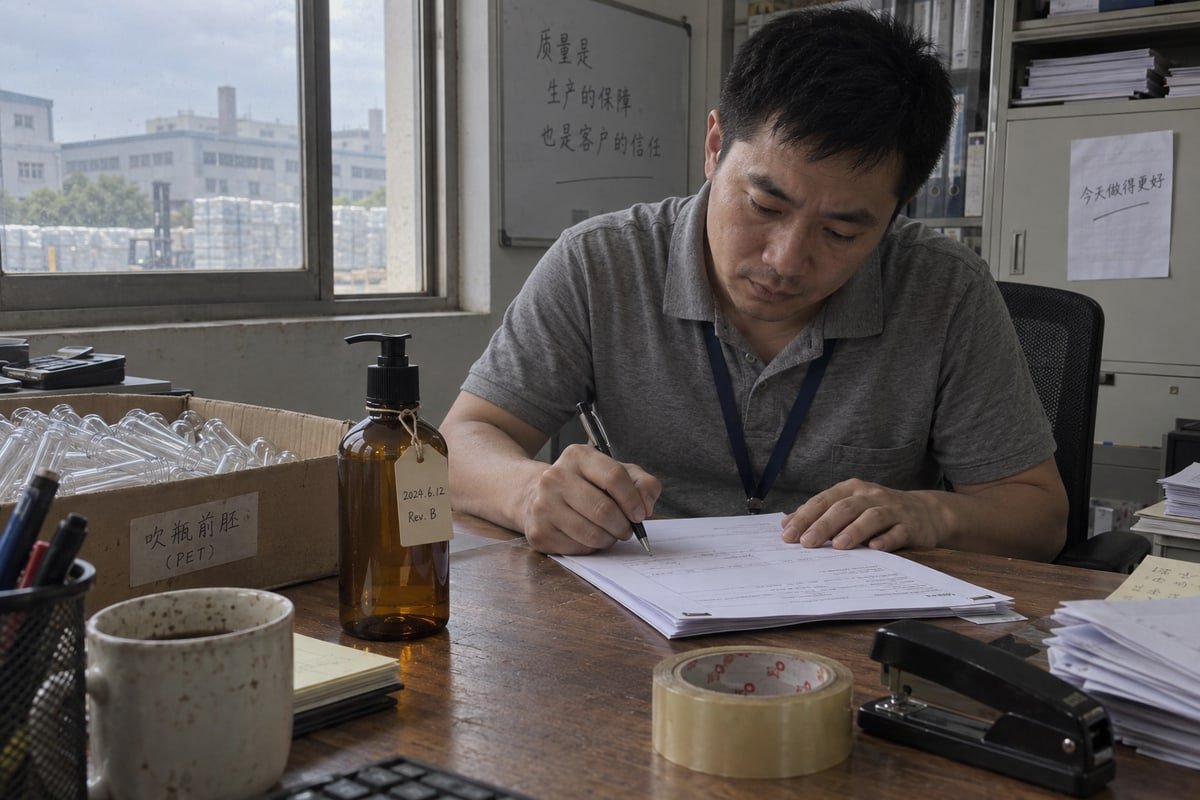
Sample sign-off in writing for PET bottle bulk orders sounds like paperwork. Yet on our production line, one vague “looks good” has caused more disputes than any machine fault.
To confirm sample sign-off in writing for PET bottle bulk orders, tie the approved physical sample to a product specification sheet, a revision number, and a signed, dated approval form. Attach that form to the purchase order and require the supplier to countersign before mass production starts.
That is the short version. The rest of this guide shows you how to build the document, what to put in it, how to stop leakage disputes, and whether a WhatsApp message can count.
How do I create a written sample sign-off document that protects my bulk order?
A German buyer once returned a PET bottle pallet to our Taizhou factory over a shade of blue. Nobody had written down which blue was approved.
Create a written sample sign-off document by naming the golden sample, listing every approved characteristic against a product specification sheet, recording the revision number and date, adding buyer and supplier signatures, and referencing the purchase order clause that makes this approval the benchmark for conforming goods.
That blue dispute taught me something simple. A sample is only a physical object. The approval document is what turns it into a production reference. Without the document, the supplier and the buyer each remember a different sample.
Start with a golden sample reference
The first step is to pick one physical bottle and name it. Call it the golden sample or master sample. Most buyers request 2 to 5 units for the pre-production sample approval 1 stage. Lead time is often 7 to 15 days, including shipping. Many suppliers, including us, offer the sample free, but the courier cost is usually charged to the buyer. Once the units arrive, choose the one that best matches the brief. That unit becomes the benchmark.
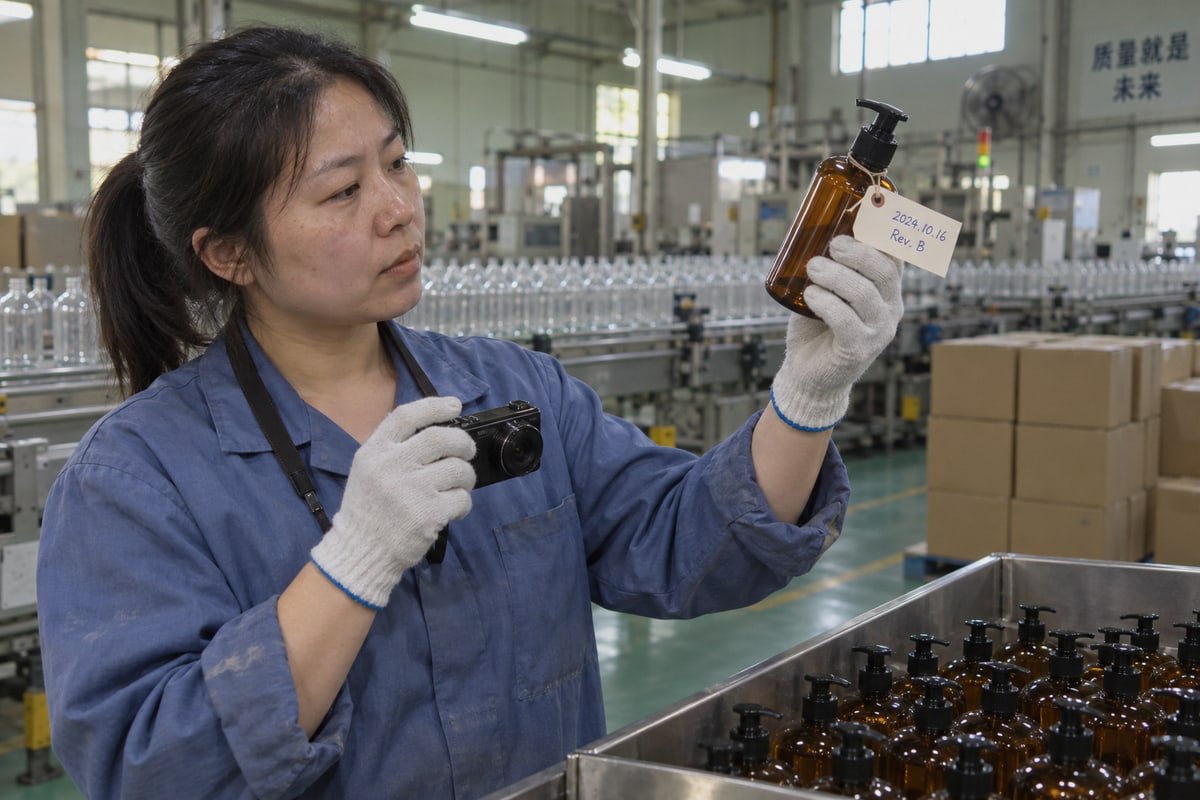
Then attach a permanent tag to it. Write the date, the revision number, and your signature on the tag. Photograph the tagged bottle in high resolution. Send that photo along with the form. Now the physical sample and the paper record point to each other.
The five parts of a protective sign-off form
| Part | What it does | Why it protects you |
|---|---|---|
| Identity block | Buyer, supplier, SKU, item number, revision | Stops confusion between sample versions |
| Specification checklist | Each approved characteristic, ticked or marked | Proves what was checked, not just that something was approved |
| Exception list | Any known difference between sample and bulk item | Removes later arguments about "you knew it would differ" |
| Signature block | Buyer signature, date, supplier countersignature | Creates a two-party record |
| Contract reference | Clause in the PO or manufacturing agreement | Makes the approval the legal benchmark for conforming goods |
Handle the "general reference" objection
Some suppliers treat a sample as a general reference, not an exact guarantee. I understand why. A hand-made or short-run sample can differ slightly from a full mold cycle. But this is exactly why the form matters. When the approval is written, revision-controlled, and tied to the contract, the sample stops being a loose reference. Any expected deviation must appear in the exception list. If it is not listed, it is not accepted. That single rule closes most gaps.
Keep a counter-sample
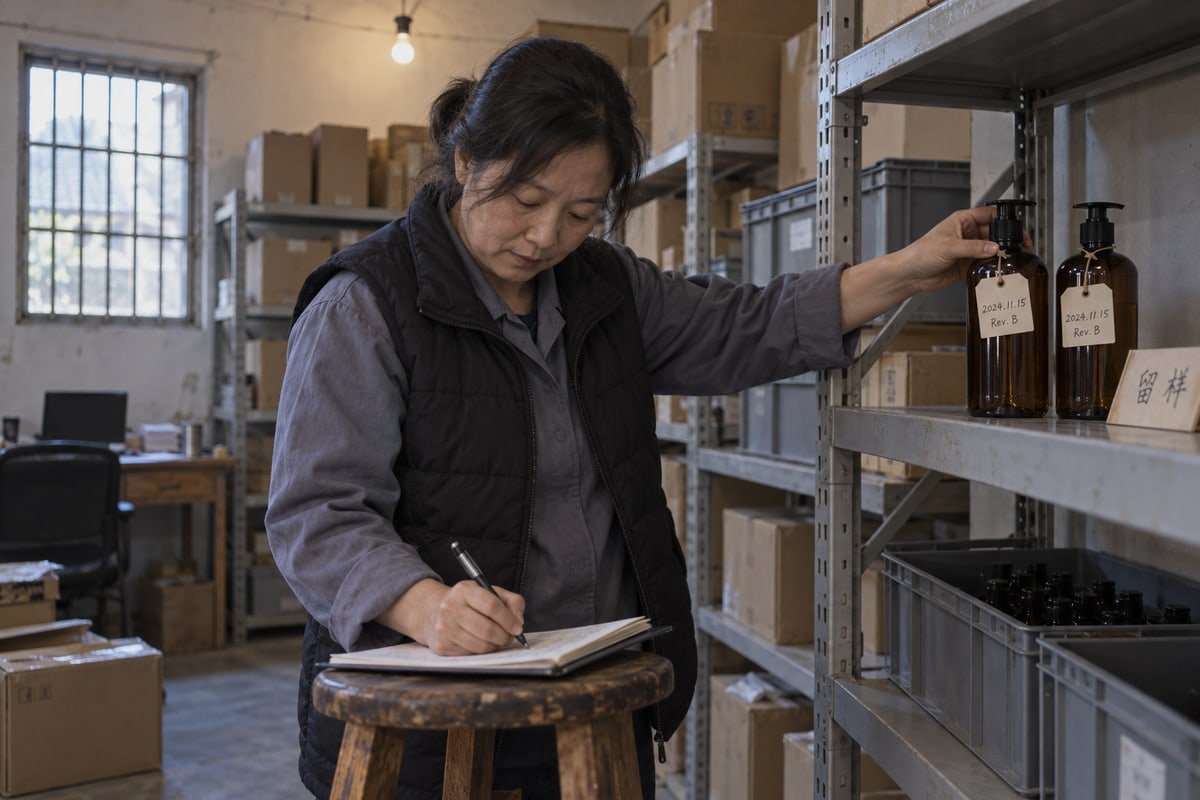
Finally, ask the supplier to keep a second identical unit. This is the counter-sample. Both parties store their unit safely, labeled as the approved benchmark. Before production begins, the supplier confirms in writing that both samples are identical. If a bulk shipment later drifts, both sides compare against the same object.
What details should I include when confirming PET bottle sample approval in writing?
Every extra line on an approval form costs the buyer time. Yet in our export work to Australia and the US, missing lines cost far more.
Include product identity, SKU, sample revision, PET resin grade and polymer supplier, gram weight, brimful capacity, neck finish dimensions, wall thickness, Pantone or Lab* color values, print and decoration accuracy, closure fit and torque, performance test results, AQL defect tolerance levels, exceptions, and dated signatures from both parties.
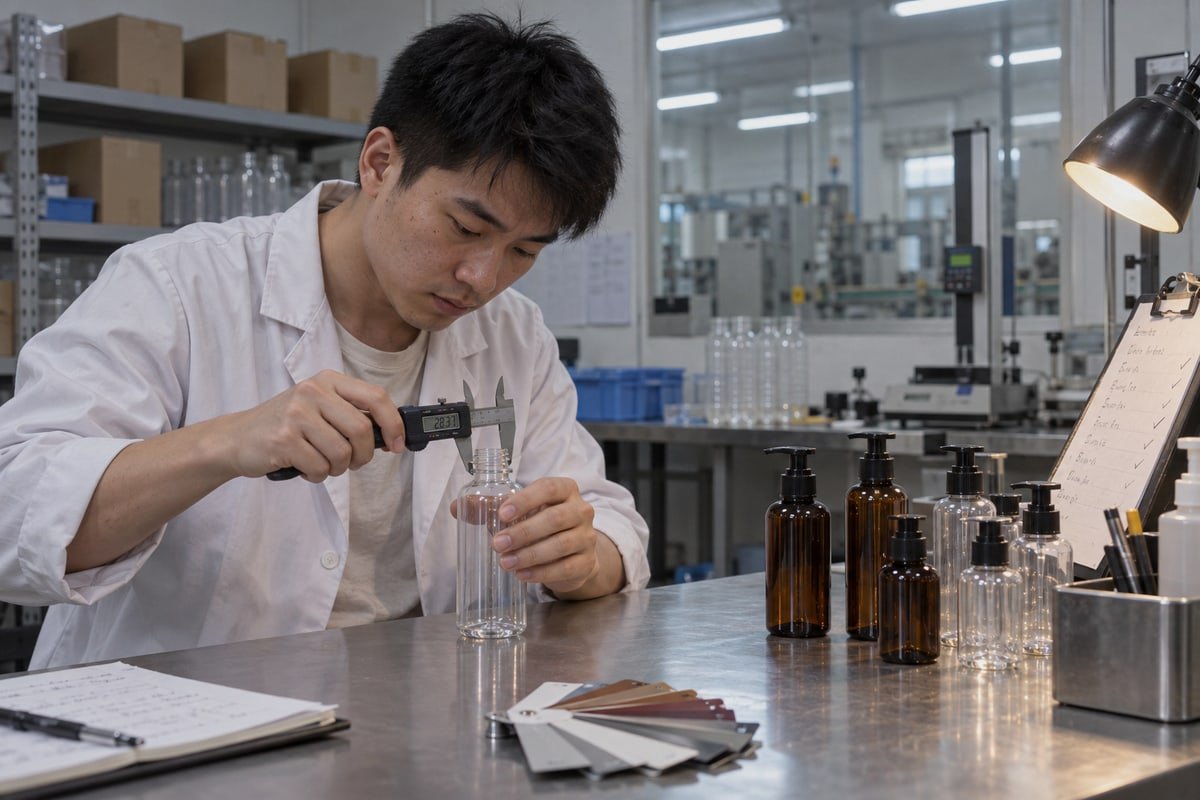
The word "approved" on its own is almost useless. It says nothing about what was measured. When we build a sign-off for a custom PET bottle, we group the details into six blocks. The table below shows how I structure it.
| Block | Details to record | Typical source |
|---|---|---|
| Identity | Product name, SKU, item number, sample revision, date | Purchase order and sample tag |
| Material | PET resin grade, polymer manufacturer 2, PCR percentage if any | Supplier declaration, certificate of analysis |
| Dimensions | Gram weight, brimful capacity, height, diameter, wall thickness, neck finish dimensions | Technical drawing and measurement report |
| Appearance | Pantone reference or Lab* values, finish, transparency or tint | Color standard and spectrophotometer reading |
| Decoration | Print position, artwork version, screen or hot-stamp accuracy | Approved artwork file |
| Performance | Closure torque, leak test, top-load, vacuum resistance | Test report from sample stage |
Lock the material with a resin grade consistency clause
PET bottles look alike on a shelf. The resin inside them does not behave alike. A different grade can change clarity, stress-crack resistance, and how the bottle reacts to essential oils or alcohol-based serums. So the form should name the exact polymer manufacturer and grade used in the sample. Add a short clause that bans substitution without written consent. Ask for a certificate of analysis for the resin lot at both the sample stage and the bulk stage. This is a small request, and it stops silent material swaps.
Define color in numbers, not adjectives
"Amber tint" means one thing to a designer and another to a molding technician. Write the color as a Pantone reference or as Lab* values with a tolerance. Transparent and tinted PET is especially sensitive to wall thickness, so record color and thickness together. For frosted or matte finishes, describe the process as well as the look.
Add a PCR variance allowance if you use recycled content
Recycled PET brings small aesthetic differences. Slight haze and occasional black specks are normal. If your sample was virgin resin but bulk will use PCR, the form must say so. Define how much clarity variance you accept. Define the maximum size and count of black spots per bottle. Otherwise the first PCR shipment will fail a visual check that was never designed for it.
Set AQL defect tolerance levels
State the inspection standard 3 and the AQL for critical, major, and minor defects. Attach a short defect list with photos where possible. Buyers who skip this step end up arguing about whether a flow line is a defect at all.
How do I avoid QC disputes and product leakage issues after sample sign-off?
Leakage was the top fear of a procurement manager in Melbourne I spoke with. Her bottles passed a visual check but failed once filled with real serum.
Avoid QC disputes and leakage by testing the sample with your actual formula and filling process before approval, recording leak-test, torque, top-load, and vacuum results in the sign-off, setting AQL defect limits, keeping labeled golden and counter-samples, and inspecting bulk output against that exact reference.
A bottle that looks perfect can still leak in a shipping container. Heat, vibration, and product chemistry all do things a showroom cannot show. So the sign-off has to cover function, not just appearance.
Test the sample under real conditions first
Before you sign, fill the sample with the real formula. Cap it with the real closure. Run it through your own filling line if you can. Then store it inverted for a few days. Ship a few units across town or across the country. Only after these steps should the approval be signed. Whether the product is a PET pump bottle or one of our amber glass dropper lines, the logic is the same. Fit and seal must be proven with the actual closure and the actual liquid.
Common leakage causes and the sign-off line that prevents them
| Leakage cause | What usually went wrong | Line to add in the sign-off |
|---|---|---|
| Neck finish out of tolerance | Bottle and cap made to different neck specs | Neck finish dimensions with tolerance, matched to the closure drawing |
| Wrong torque | Cap under- or over-tightened during filling | Application torque and removal torque range |
| Thin wall at shoulder | Uneven material distribution during blowing | Minimum wall thickness at three points |
| Pump or dropper seal mismatch | Liner or gasket not compatible with formula | Compatibility test result with the real product |
| Resin substitution | Bulk grade differs from sample grade | Resin grade consistency clause and certificate of analysis |
Write down the quality control specifications, not just the result
Recording "leak test passed" is not enough. Record how the test was done. Note the pressure or vacuum level, the hold time, and the number of units tested. Do the same for top-load strength. These numbers become the batch consistency standards for every future run. When an inspector opens a bulk carton, they know exactly what to replicate.
Inspect against the golden sample, not against memory
Give your inspector, or your third-party inspection agency, a copy of the signed form and access to the counter-sample. Comparison should be sample-to-sample. This prevents the most common dispute I see. The buyer says the bottle is wrong. The supplier says it matches the sample. Neither can prove it, because nobody kept a labeled reference. A controlled golden sample settles that argument in minutes.
Can email or WhatsApp confirmation serve as valid sign-off before mass production starts?
We learned the hard way that a thumbs-up emoji is not mass production authorization. Most of our Australian buyers prefer WhatsApp, so we built a process around it.
Yes, email or WhatsApp confirmation can serve as valid sign-off if the message clearly identifies the sample revision, attaches the signed approval form and a photo of the tagged sample, states any exceptions, references the purchase order, and receives a written acknowledgement from the supplier.
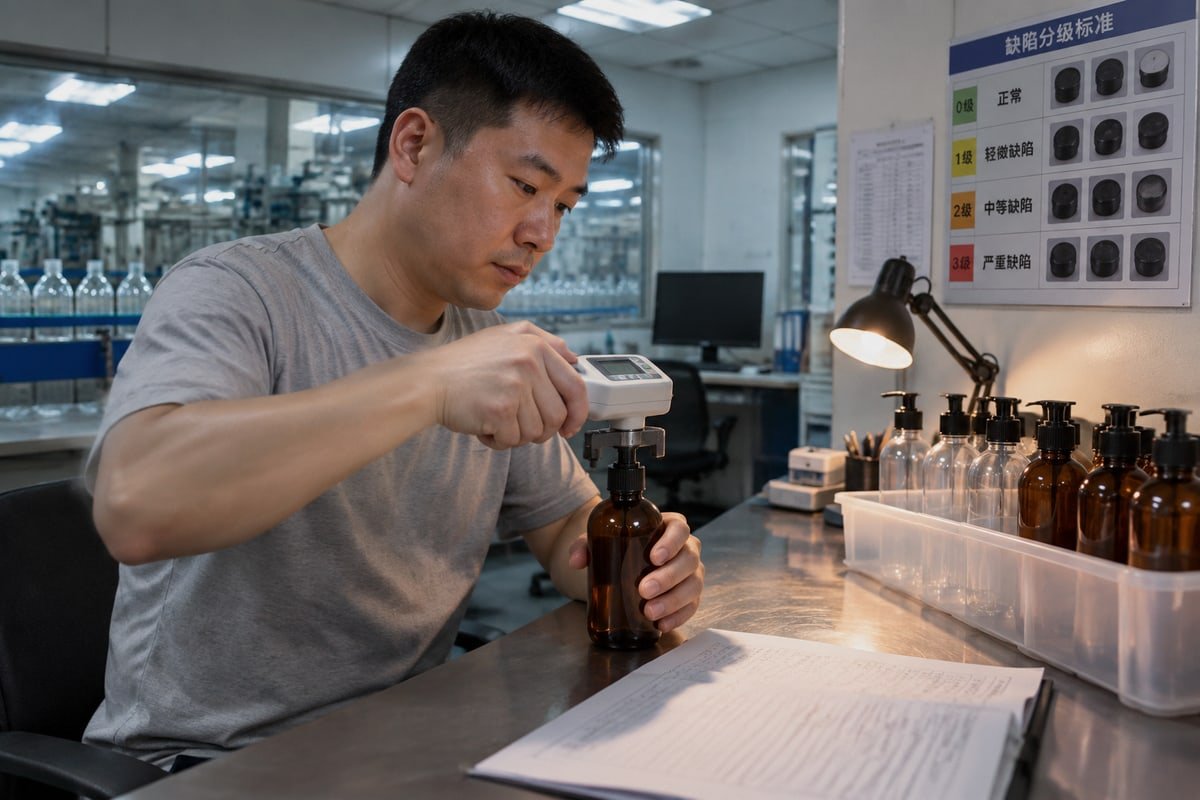
I do not want to tell busy procurement managers to stop using WhatsApp. It is fast, and it works across time zones between China and Australia. The problem is not the channel. The problem is the content of the message. A weak message is vague. A strong message carries the full chain of proof.
Weak message versus strong message
| Element | Weak confirmation | Strong confirmation |
|---|---|---|
| Sample identity | "The sample is fine" | "Approving sample Rev C, item 5021, received 12 March" |
| Evidence | None | Signed PDF form plus photo of the signed tag |
| Scope | Implies everything is approved | Lists what was checked and any exceptions |
| Contract link | No reference | "Per PO 4471, clause 6, this is the production benchmark" |
| Supplier reply | Silence or an emoji | Written acknowledgement quoting the revision |
What a valid message must contain
- The exact revision number of the approved sample.
- A scanned or photographed copy of the signed approval form.
- A photo of the golden sample with its signed and dated tag visible.
- A short exception list, or a clear statement that there are none.
- The purchase order or contract reference.
- A request for the supplier to reply with written acknowledgement.
When all six are present, the WhatsApp thread becomes an audit trail. When any are missing, it becomes a memory contest.
Add a digital anchor for version control
The current trend in packaging procurement is toward version-controlled, evidence-based approval. One practical step is to print a QR code on the sample tag. The code links to a cloud folder that holds the technical drawings 4, the test report, and the approval timestamp. Some buyers go further and store a cryptographic hash of the approval file, so any later edit is detectable. You do not need advanced software for this. A locked shared folder with a dated PDF already beats a loose photo.
Keep the formal document as the master
My rule is simple. The chat confirms. The document governs. If the WhatsApp message and the signed form ever disagree, the signed form wins. State that rule in the manufacturing agreement. It keeps informal channels useful without letting them replace the pre-production sample approval record. And it means production never starts on a single word or emoji.
Conclusion
Verbal approval leaves your bulk order exposed. Turn the sample into a signed, versioned, tested record, and every PET bottle that leaves the line has a clear benchmark.
Footnotes
1. ISO 9001 provides the international standard for quality management systems and production approval processes. ↩︎
2. Direct link to the FDA inventory that lists approved manufacturers of food-contact polymers. ↩︎
3. The WTO TBT Agreement ensures that technical regulations and standards do not create unnecessary obstacles to international trade. ↩︎
4. Engineering drawings provide the standardized graphical language used to communicate technical requirements and dimensions in manufacturing. ↩︎
