
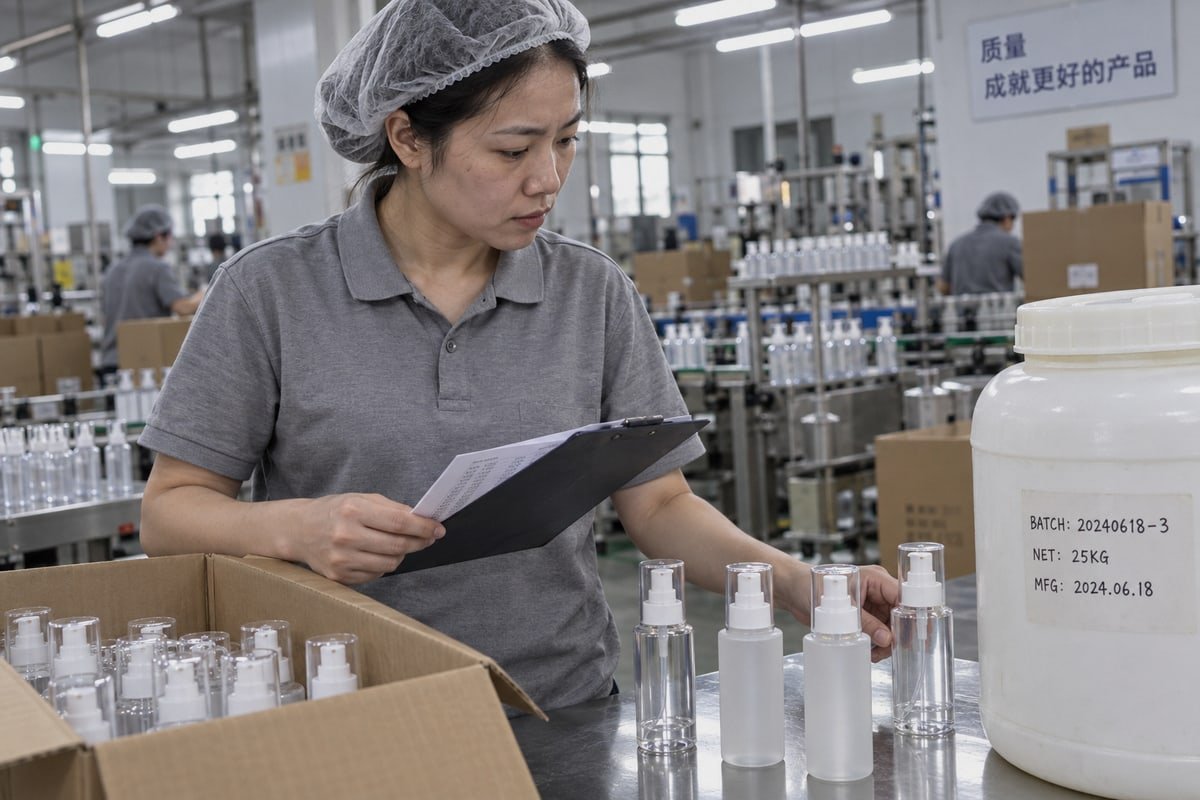
Ordering PET bottles should be simple. Yet on our packing floor in Taizhou, I have watched a PET bottle material grade 1 mismatch turn a clean order into a costly return.
To verify PET bottle material grade, match the delivered lot against your purchase specification using a lot-specific certificate of analysis, then confirm intrinsic viscosity, acetaldehyde, moisture, and color through independent lab tests, and run a production trial before releasing the shipment.
Paperwork alone will not protect you. The bottles in the carton must match the words on the certificate FDA 21 CFR food grade compliance 2. Below, I walk through the documents, the tests, the certifications, and the fallback plan we use when a lot fails.
What documents should I request to confirm PET bottle material grade before shipment?
Last year a resin drum arrived at our Taizhou factory with a certificate dated three months earlier ISO 9001 quality system certification 3. The lot number on the paper did not match the drum label.
Request a lot-specific certificate of analysis, the resin technical data sheet, food grade or cosmetic compliance declarations, an accredited third-party lab report, and resin batch traceability records that link the resin lot to your preforms and finished PET bottles before shipment.

That drum taught us a simple rule. A document only counts if it points to the exact material in front of you REACH SVHC statements 4. Everything else is marketing.
Start by defining what "grade" means on your purchase order
"PET bottle material grade" can mean four different things. It can mean virgin bottle-grade PET. It can mean food-contact compliant PET. It can mean a specialty low-acetaldehyde resin. Or it can mean recycled PET with a defined intrinsic viscosity range. When we quote a custom serum bottle for a brand owner, we write the grade type into the specification first. If the spec is vague, no certificate can confirm it.
Grade is not only chemistry. It also includes intrinsic viscosity, acetaldehyde limits, moisture, color, contamination limits, and the intended use. Your purchase specification should list all of these with a target value and a tolerance.
The document checklist we send to resin suppliers
| Document | What it must show | Why it matters |
|---|---|---|
| Certificate of Analysis (COA) | Lot number, test date, IV, MFI, AA, moisture, color, test methods | Confirms the actual shipped lot, not an average batch |
| Technical Data Sheet (TDS) | Grade name, typical properties, recommended processing | Defines the intended grade so you can compare it to the COA |
| Compliance declaration | FDA or EU food grade compliance, cosmetic packaging suitability | Ties safety claims to the exact resin grade |
| Third-party lab report | Accredited lab name, sample lot, methods, results | Independent proof beyond the supplier's own numbers |
| Resin batch traceability records | Resin lot to preform lot to bottle lot | Shows the material was not co-mingled or substituted |
How to perform certificate of analysis verification
The COA is your first screen. But it is only useful if you check three things. First, cross-reference the batch number on the physical packaging with the batch number on the COA. Second, check that the test date is recent and belongs to this production run. Third, confirm the COA lists the test method for each value. An IV number with no method, such as a note that it followed the ASTM D4603 standard 5, is a red flag.
Some of our larger customers now ask for digital traceability logs. A few suppliers offer blockchain-enabled records that show the chain of custody from resin plant to molding line. I find this helpful for one reason. It makes it harder for anyone to blend lower-grade regrind into a lot during transit without leaving a trace.
Red flags I look for in the paperwork
A generic brochure instead of a recent COA is the most common problem. Broad IV ranges with no method details come next. Claims of FDA or EU compliance that cannot be tied to the current material or a valid certificate round out the list. When I see two of these together, I hold the shipment until the supplier sends corrected documents.
How can I test incoming PET bottles to verify they match the agreed material grade?
Every incoming lot forces a choice between speed and certainty. Our QC team weighs a quick spot check against a full lab panel on almost every PET shipment.
Test incoming PET bottles by pulling samples from several cartons, then running intrinsic viscosity testing, acetaldehyde concentration analysis, moisture content analysis, color measurement, and FTIR or DSC checks, followed by leak, drop, and top-load tests on finished bottles against the agreed specification.

Some buyers tell me lab testing is overkill. They trust the factory audit and the supplier's certificates. I understand the cost concern. But paperwork only proves the claim is consistent. Only a test on the delivered material proves the material is right. We use both, and I recommend you do the same.
The core lab tests and what each one tells you
| Test | Method | What it confirms | Typical concern |
|---|---|---|---|
| Intrinsic viscosity (IV) | Capillary viscometer, ASTM D4603 standard | Molecular weight and processability | Bottle-grade PET usually sits around 0.65 to 0.85 dl/g |
| Acetaldehyde (AA) | Gas chromatography | Odor and taste impact, degradation level | Critical for beverages, relevant for fragrance-sensitive skincare |
| Moisture content analysis | Karl Fischer titration | Proper drying and storage | Wet resin causes IV drop and hazy bottles |
| Color values | Spectrophotometer, L*, a*, b* | Clarity, yellowing, contamination | Elevated b* signals heat damage or regrind |
| Differential scanning calorimetry (DSC) | Thermal property testing | Melting point, glass transition, polymer crystallinity | Identifies grade and detects blended material |
| FTIR spectroscopy analysis | Infrared absorption | Chemical identity, additives, contamination | Catches non-PET material or unknown additives |
| Melt flow index (MFI) | Melt indexer | Cross-check of flow behavior | Useful when recycled content is involved |
Intrinsic viscosity testing is the anchor. If the IV is outside the agreed range, nothing else matters. Differential scanning calorimetry adds a second layer. Melting point and glass transition temperature act like fingerprints for a specific grade. Some labs also run an isothermal crystallization rate test. That number predicts how the resin will behave in high-speed injection molding compared with the expected grade profile.
Fast field checks before the lab
We do not send every lot to a lab on day one. First, we run a receiving inspection. We check labels, seals, quantity, and lot numbers. Then we pull retention samples from multiple points in the shipment, not just the top carton. Some of our customers in Germany use handheld near-infrared (NIR) spectroscopy at the dock. It compares the resin signature against a stored baseline in seconds. It is not a replacement for a lab, but it flags obvious substitutions fast.
Physical tests on finished bottles
Chemistry does not tell the whole story. A resin can pass IV and still produce a bottle that fails. So our incoming quality control also includes finished-bottle checks:
- Dimensional check of neck finish and thread against the drawing.
- Leak test with the actual pump or dropper closure fitted.
- Drop test from a set height with product-weight fill.
- Top-load test to confirm stacking strength.
- Fit test with the customer's cap, collar, and outer carton.
Leakage is the number one complaint we hear from procurement managers. Most leaks trace back to a neck dimension drift or a wall thickness change. Both can come from a grade or process mismatch. Physical tests catch what the COA cannot.
How much testing is enough?
Here I weigh a real trade-off. For a low-risk, non-food decorative bottle, a COA check plus visual and fit tests may be enough. For a facial serum in a clear PET bottle bound for the US or EU, the burden is much higher. A failure there means a recall, not a refund. We scale the test panel to the risk.
Which certifications help me ensure my supplier's PET resin meets cosmetic packaging standards?
A procurement manager in Australia once asked me for a single certificate that would prove her PET serum bottles were safe. I had to explain there is no single paper.
Useful certifications include FDA 21 CFR food grade compliance, EU Regulation 10/2011 declarations, ISO 9001 quality system certification, REACH SVHC statements, ISO/IEC 17025 accredited lab reports, and recycled-content certificates when rPET is used, all tied to the specific resin grade.

Cosmetic packaging sits in a gray zone. Most regions do not have a dedicated PET standard for skincare bottles. So the industry borrows from food-contact rules. A resin that meets food grade compliance is treated as safe for creams, serums, and toners. That is why we ask our resin partners for food-contact documents even when the bottle will never hold a drink.
The certification map we use for our export markets
| Certification or document | Issuing body or basis | Covers | Best for |
|---|---|---|---|
| FDA 21 CFR food contact compliance | US FDA regulations | Resin suitability for food contact | US market shipments |
| EU Regulation 10/2011 declaration | European Commission | Plastics intended for food contact, migration limits | Germany and wider EU |
| REACH SVHC statement | EU chemicals regulation | Absence of restricted substances | EU and many Australian brand owners |
| ISO 9001 6 | Accredited certification body | Supplier quality management system | Consistency of production, not resin identity |
| ISO/IEC 17025 lab accreditation | National accreditation bodies | Competence of the testing lab | Trusting third-party test reports |
| Recycled-content certification | Recognized certification schemes | Verified PCR percentage and source | rPET or hybrid grades |
Why a system certificate and a material certificate are different
ISO 9001 tells you the supplier has a process. It does not tell you the resin is bottle grade. A food-contact declaration tells you the grade is suitable. It does not tell you this lot was made correctly. An ISO/IEC 17025 lab report tells you a competent lab measured this lot. You need all three layers to close the loop.
Special rules for recycled PET
Many of our brand-owner customers now want rPET for sustainability reasons. I support this. But recycled material varies more than virgin resin. Contamination, purity, moisture, and IV all swing wider from lot to lot. So the verification steps get stricter, not lighter. We ask for the cleaning and decontamination process description, contaminant limits, and a recycled-content certificate.
If you buy a hybrid grade, verify the virgin-to-recycled ratio. Some labs use carbon-14 dating or tracer additives to audit the post-consumer resin percentage. Without this check, a supplier can sell mostly virgin material at an rPET premium, or worse, sell heavy regrind as bottle grade.
Matching certificates to the exact grade
Here is the trap I see most often. A supplier holds a valid food-contact certificate for one grade. Then they ship a different grade under the same paperwork. So we always check that the grade name on the certificate matches the grade name on the COA, the TDS, and the drum label. If any one of those four names differs, we ask for an explanation before the goods leave China.
What steps can I take if the delivered PET bottles don't match the specified material grade?
The hardest lesson I learned in packaging came from a rushed release. We approved a PET lot on paperwork alone, and the pumps later leaked in transit to Germany.
Quarantine the nonconforming lot immediately, document the mismatch with photos and lot numbers, retest at an independent accredited lab, notify the supplier in writing, then reject, downgrade, or rework the material under your contract terms, and record the outcome on a supplier scorecard.
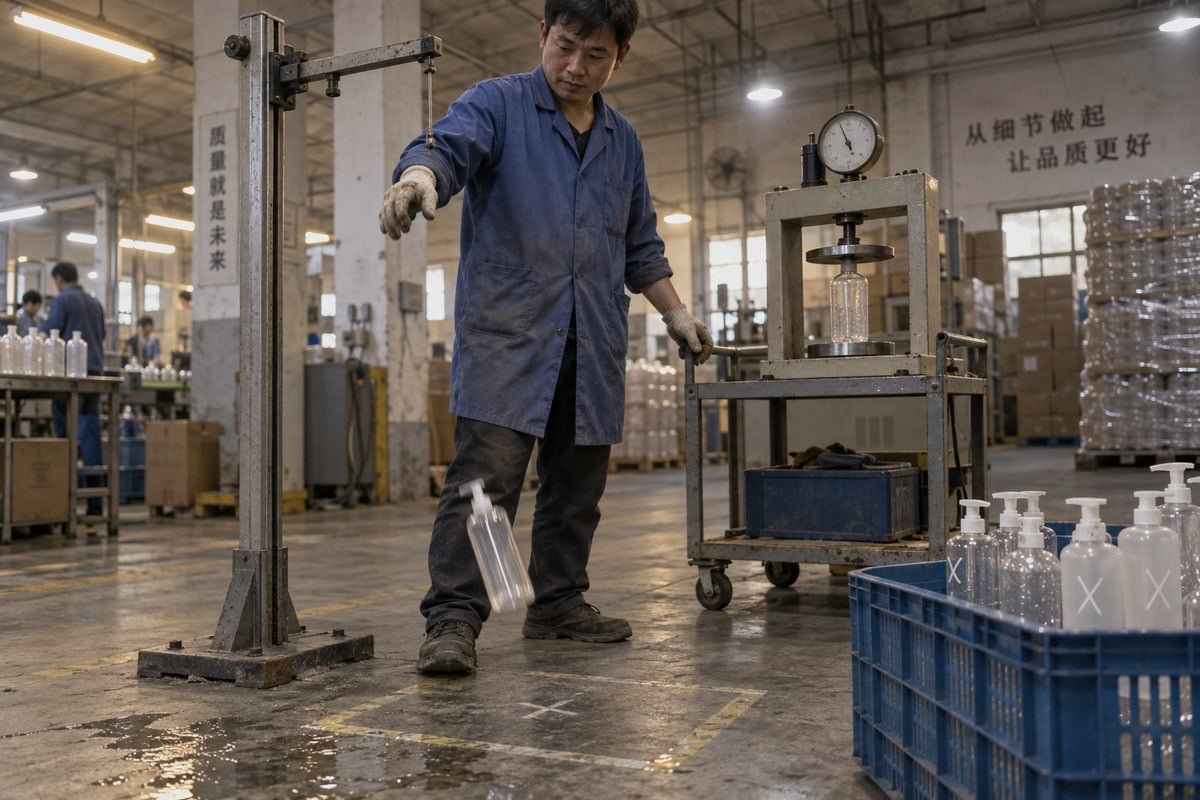
That leak cost us a reshipment and a customer's trust. Since then, we treat a grade mismatch as a controlled event with fixed steps. Panic leads to bad decisions. A checklist leads to a fair outcome for both sides.
The seven-step response we follow
- Quarantine. Move the lot to a marked hold area. Tag every pallet. Nobody molds or fills from it.
- Document. Photograph the labels, the seals, and the COA side by side. Record every lot number.
- Retest. Send retention samples to an independent lab. Repeat intrinsic viscosity testing and any test that failed. Add FTIR spectroscopy analysis if you suspect blended or non-PET material.
- Notify. Send the supplier a written nonconformance report within days, not weeks. Attach the lab data.
- Decide. Reject, downgrade, or rework based on the results and the intended use.
- Recover. Apply your contract terms for replacement, credit, or chargeback.
- Record. Update the supplier scorecard and adjust your incoming inspection level for the next lot.
Matching the response to the type of mismatch
| Mismatch found | Typical root cause | Reasonable action |
|---|---|---|
| IV below range | Wet resin, degraded lot, regrind blend | Reject for clear bottles; downgrade to opaque non-critical parts if allowed |
| High acetaldehyde concentration | Overheating during processing | Reject for fragrance-sensitive products; retest after supplier correction |
| Yellow b* value out of spec | Heat damage or contamination | Reject for clear bottles; possible use in colored bottles |
| Wrong grade name on label | Substitution or co-mingled inventory | Reject and demand full resin batch traceability records |
| Unverified PCR percentage | Missing certification or tracer data | Hold until certified; renegotiate price if ratio differs |
Why contract language decides the outcome
Many disputes drag on because the purchase order never defined "nonconforming." Write it in. State the grade, the IV range, the AA limit, the color window, and the test methods. State who pays for the independent lab. State the remedy. When our customers in the US ask for DDP terms, we also agree in advance on who bears freight for a rejected lot. That one clause has saved weeks of back-and-forth.
Keep the door open with good suppliers
One failed lot does not always mean a bad supplier. Sometimes a warehouse mixed two drums. Sometimes a COA was attached to the wrong pallet. A clear corrective action plan, plus a tighter inspection on the next two shipments, often fixes the problem. But if the same supplier fails twice, we move them off the approved list. Delays and returns hurt the brand owner far more than a supplier change hurts us.
Conclusion
A mismatched PET bottle material grade can cost you a season of sales. Verify each lot with documents, tests, and trials, and you keep leaks and returns off your desk.
Footnotes
1. Comprehensive overview of the chemical and physical properties of PET resin. ↩︎
2. Primary US regulatory resource for food-contact material safety and compliance. ↩︎
3. Official ISO page for the quality management standard mentioned in the article. ↩︎
4. Official list of substances of very high concern regulated under REACH. ↩︎
5. Industry-standard test method for determining the intrinsic viscosity of PET. ↩︎
6. Official ISO page defining the quality management standard referenced for supplier certification. ↩︎
