
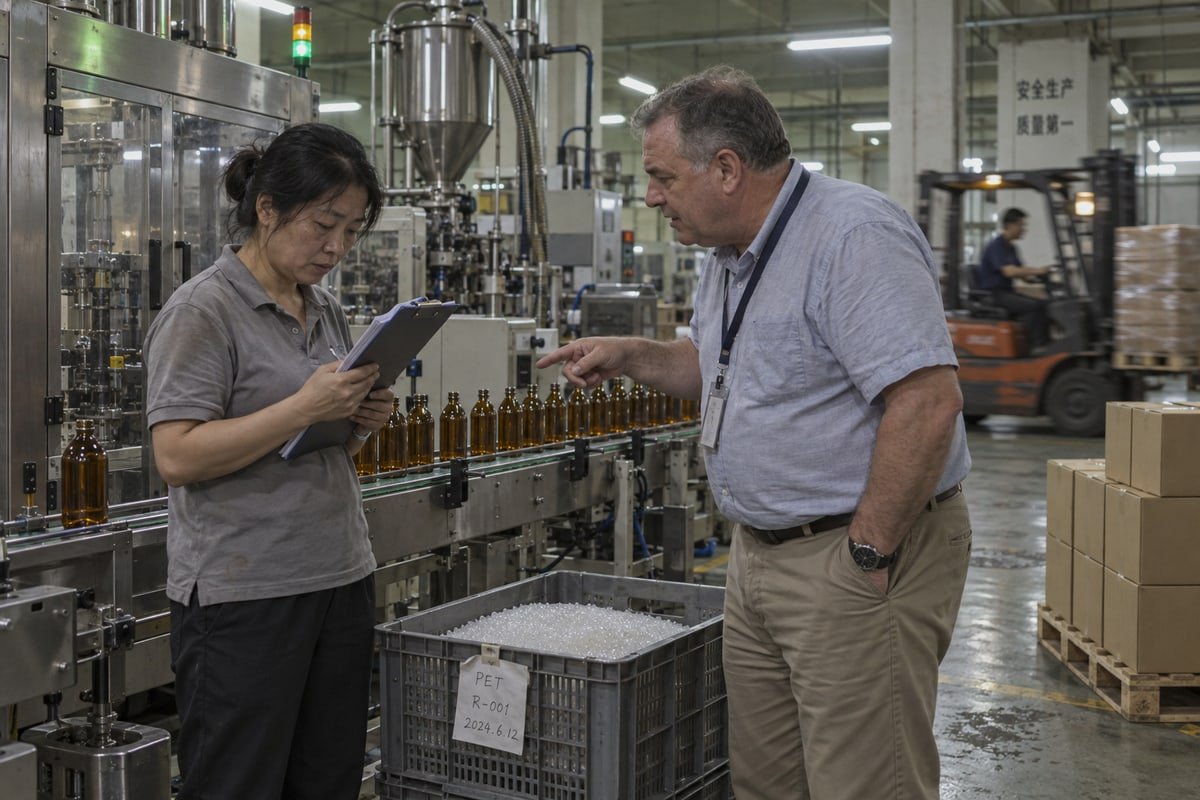
Vetting PET bottle suppliers for raw material sourcing and batch traceability 1 saved one of my clients from a costly recall. On our production line in Taizhou, I have seen why it matters.
Ask PET bottle suppliers to name the resin producer and grade, provide a batch-specific Certificate of Analysis, and prove each finished bottle batch traces back to its preform lot and resin batch ID. Also request food-contact compliance documents, incoming inspection records, and rPET chain-of-custody evidence.
That is the short answer. Below, I break it down into four practical steps. Each step includes the exact questions to ask and the documents to request.
How can I verify my PET bottle supplier's raw material sourcing before placing an order?
A procurement manager from Melbourne once asked me a question no other buyer had: "Who makes your resin?" That single question told me she understood raw material sourcing better than most.
Verify raw material sourcing by asking the supplier to name the PET resin producer, the exact grade, and the country of origin. Then cross-check with a batch-specific Certificate of Analysis, food-contact compliance statements, and evidence of a documented raw-material approval process.
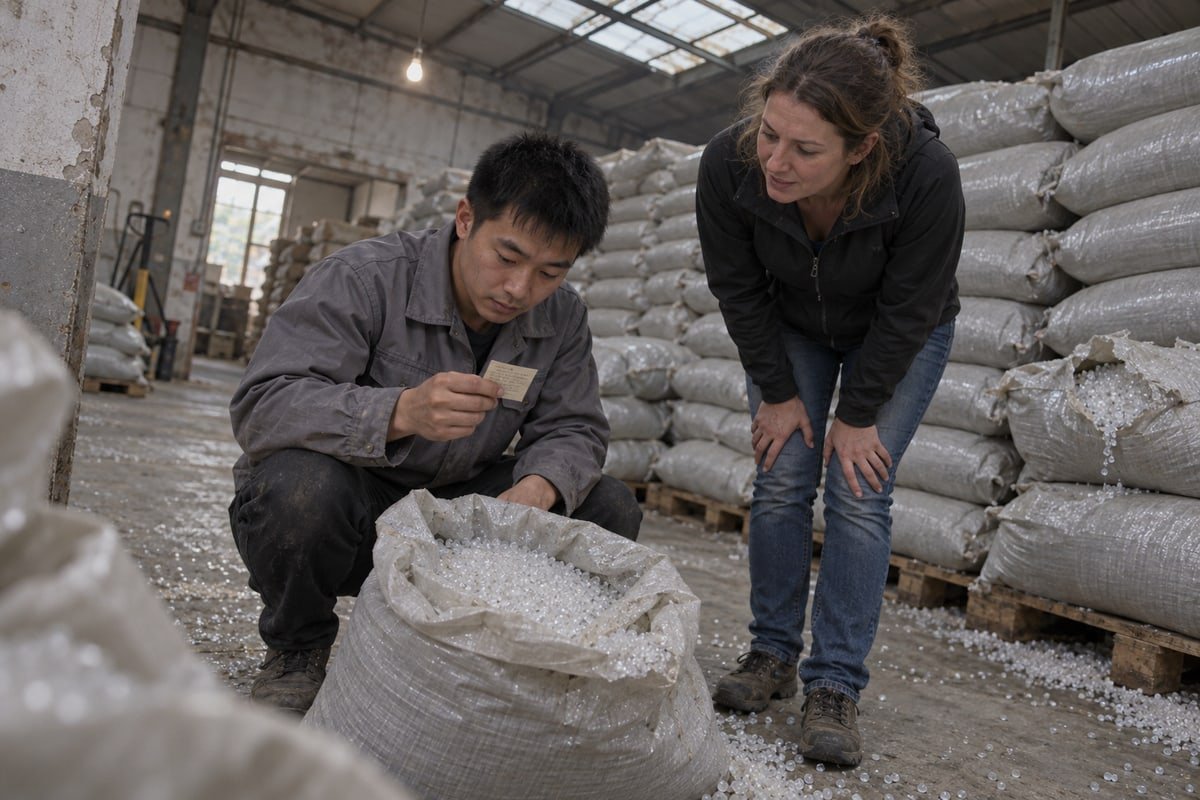
Many suppliers will simply say their material is "food grade PET 2" and stop there. That answer is not verification. It is a label. In our own sourcing process, we keep records that identify the resin producer, the grade number, and the batch numbers of every delivery. You should expect the same from any PET bottle supplier you evaluate.
What "named sourcing" actually looks like
A credible supplier can tell you three things without hesitation: who produced the resin, which grade it is, and where it came from. Buyers increasingly expect named resin sources, not vague claims. If a supplier hesitates, that hesitation is data.
Some suppliers will push back. They argue that naming resin vendors is commercially sensitive. I understand that concern. But there is a workable middle ground. You do not need every internal machine setting. You do need enough information to trace each batch back to the resin source. A supplier who refuses even that level of supply chain transparency is signaling risk.
Go one tier deeper when the stakes are high
For regulated or high-volume programs, ask about Tier 2 sourcing too. That means the origin of Purified Terephthalic Acid 3 (PTA) and Monoethylene Glycol (MEG), the two main feedstocks for PET. This helps you assess upstream geopolitical and environmental risks before they become your problem.
| Question to Ask | Strong Answer | Weak Answer |
|---|---|---|
| Who is your resin producer? | Named producer and grade number | "It's food grade PET" |
| Where does the resin originate? | Country and plant identified | "Asia" or no answer |
| How do you approve new raw materials? | Documented approval and change control | "We trust our supplier" |
| Can you show Tier 2 feedstock origin? | PTA/MEG sourcing summary | Refusal or confusion |
What batch traceability documentation should I request to avoid quality control issues?
When we set up our lot tracking system years ago, the hardest part was not the software. It was linking every finished carton back to a specific resin delivery.
Request a batch-specific Certificate of Analysis, records showing resin batch ID, preform lot number, production date and time, plant and line identification, plus incoming inspection logs. Verify the supplier can link these records together, not just hand you isolated certificates.
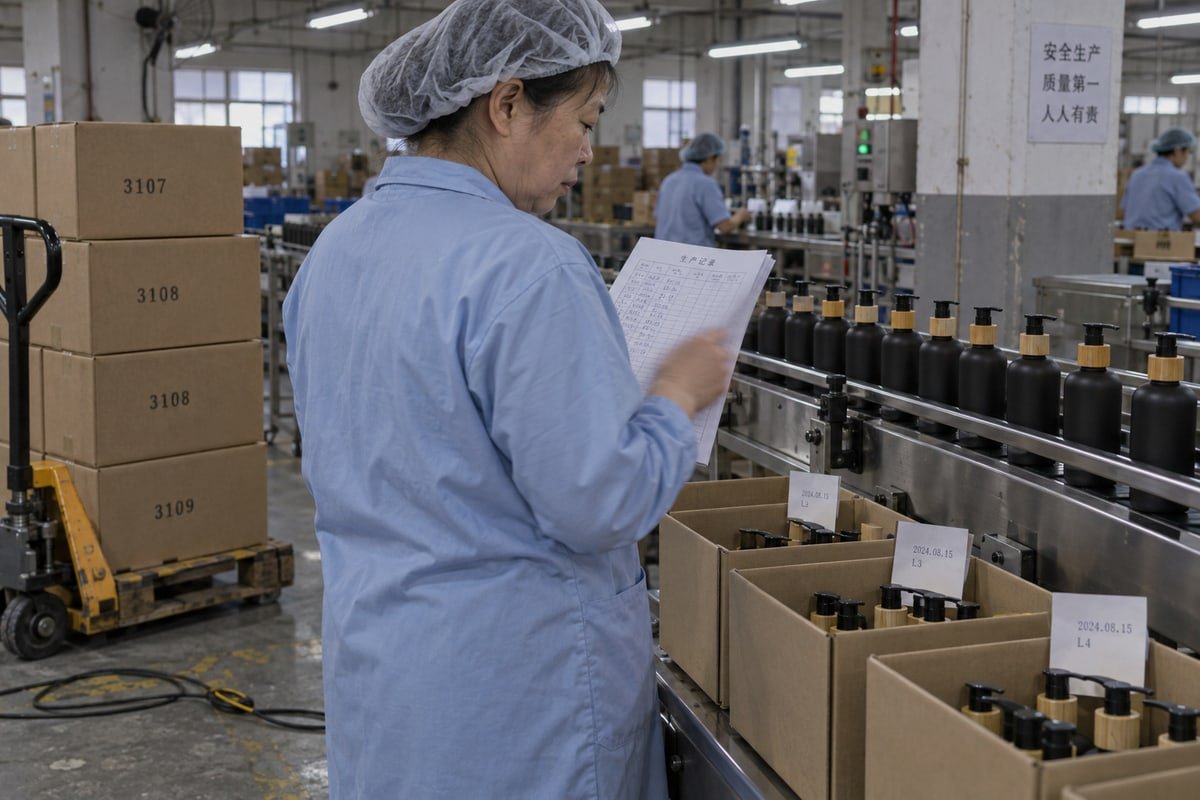
Here is the distinction that matters most: a certificate is not traceability. A summary Certificate of Analysis tells you what a batch of resin tested at. True batch traceability tells you which batch of resin went into which bottles, made on which line, on which date. Many procurement teams now treat summary-only documentation as insufficient. It cannot support recall response or root-cause analysis when something goes wrong.
The core data every converter should record
A properly run converter records the supplier name, raw-material grade, batch number, production date, plant identity, and production-line identifiers. Traceability should extend all the way down to raw-material lot numbers and resin batch IDs. If your supplier's records stop at "we bought resin in March," walk away.
| Document | What It Proves | Red Flag If Missing |
|---|---|---|
| Certificate of Analysis (per resin batch) | Physical properties, purity, food-grade compliance | Generic CoA with no batch number |
| Preform lot records | Link between resin batch and preform lot | Preforms with no lot marking |
| Production logs | Date, time, plant, and line for each batch | Handwritten or reconstructed records |
| Incoming inspection reports | Materials were checked before use | "We inspect visually" only |
| Material Safety Data Sheet | Handling and composition data | Outdated or missing SDS |
Test their retrieval speed
Static paperwork is not enough anymore. Buyers in beverage and regulated packaging now ask for fast retrieval of lot history. A practical benchmark: full "one-step-back" traceability data delivered within 24 hours, in line with expectations shaped by regulations like FSMA 204. Suppliers with digital traceability, using QR codes and ERP or MES-linked records, can usually meet that. Suppliers relying on isolated spreadsheets usually cannot. Ask them to run a mock trace on a past batch during your supplier audit. Time it. The result tells you more than any brochure.
For advanced programs, ask whether the supplier supports GS1 EPCIS standards for event-based data sharing, so batch data flows directly into your own visibility platform.
How do I ensure my supplier's raw material quality prevents product leakage during shipping?
Leakage complaints are the pain point I hear most from Australian and US buyers. In our experience exporting cosmetic packaging, most leakage traces back to material or process drift, not shipping damage.
Prevent leakage by confirming the supplier uses consistent food-grade PET resin from approved sources, enforces incoming inspection and change control, and performs wall thickness, closure torque, and seal integrity checks on every batch. Inconsistent resin and unapproved substitutions are the hidden causes of leaks.

Buyers usually blame leakage on caps or freight handling. Sometimes they are right. But in many cases I have investigated, the root cause sits further upstream. When a supplier quietly switches resin grades or blends in unapproved regrind, wall thickness distribution changes. Neck finish dimensions drift. Threads no longer mate cleanly with closures. The bottle looks identical. It leaks anyway.
Follow the chain from resin to sealed bottle
Think of leakage prevention as a chain with four links. Each link needs its own control.
- Resin consistency. The supplier should use approved food-grade PET resin with a batch-specific CoA. Intrinsic viscosity variation between batches changes how material flows during molding.
- Change control. Any resin substitution should trigger a documented approval, new samples, and buyer notification. Ask directly: "What happens if your resin supplier changes?"
- Process verification. Quality assurance protocols should include wall thickness checks, top-load testing, and neck finish dimensional checks on every production run.
- Seal integrity testing. Torque testing and leak testing on the finished bottle-and-closure system, ideally under conditions that simulate shipping vibration and temperature swings.
Connect traceability to leakage response
This is where batch traceability pays for itself. When one of my clients reported leaking units, we traced the complaint to a single preform lot within a day. We isolated that lot, replaced affected goods, and the rest of the shipment stayed in the market. Without a lot tracking system, the client would have quarantined everything. Ask your supplier how they would handle the same scenario. Suppliers holding ISO 22000 certification or GFSI-recognized schemes generally have this recall readiness built in, because their systems require it.
What questions should I ask about resin origin and certification to protect my brand's reputation?
A lesson I learned the hard way: a brand's reputation can be damaged by a sustainability claim it cannot prove. One buyer of ours nearly printed "50% recycled" on packaging before asking us for the paperwork behind it.
Ask for GFSI-recognized certifications like BRCGS or SQF, FDA compliance documentation, EU declarations of compliance, and migration test reports. For recycled content, demand the exact virgin-versus-PCR percentage, backed by GRS chain-of-custody certification, mass balance reports, and feedstock origin records.
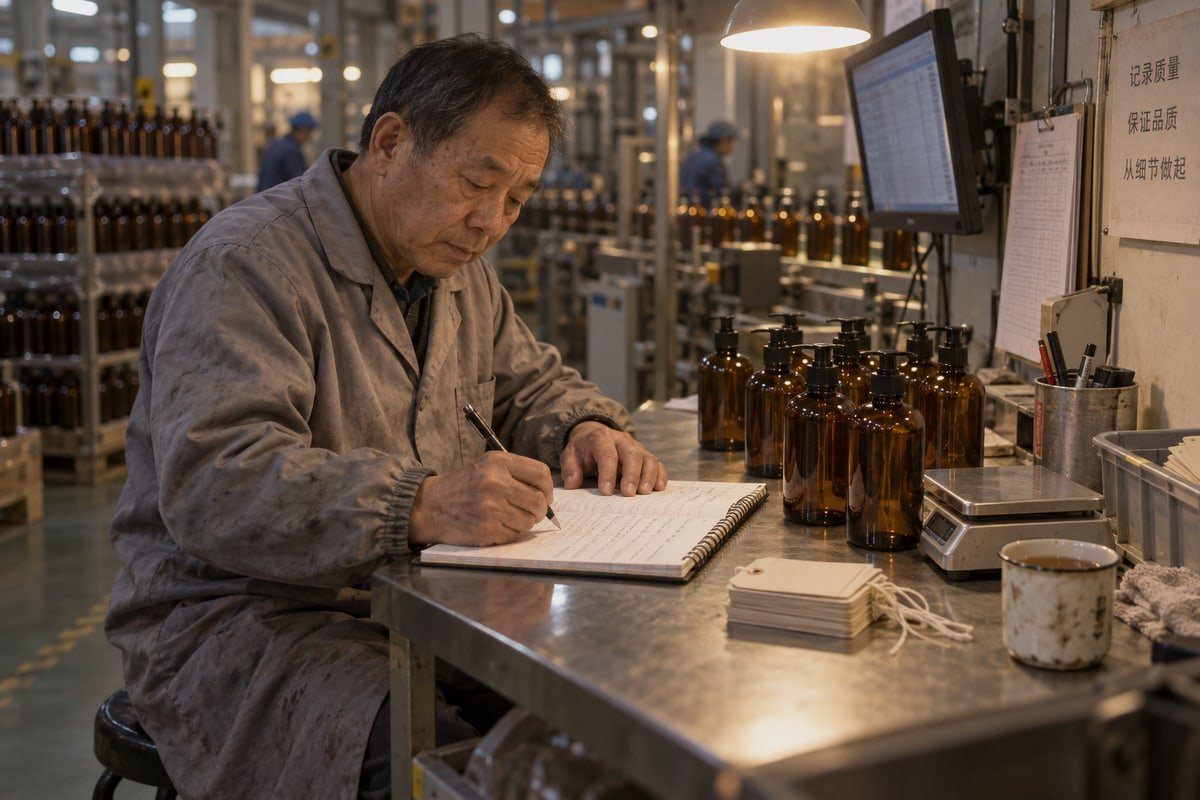
Certification questions fall into two buckets: food-contact safety and sustainability claims. Both can hurt your brand if the paperwork behind them is weak. Regulators police the first. Consumers and journalists increasingly police the second.
The certification checklist
| Claim You Make | Documentation to Demand | Certifying Framework |
|---|---|---|
| Food-contact safe | FDA compliance statements, EU declaration of compliance, migration test reports | FDA, EU food-contact regulations |
| Audited quality system | Third-party supplier audit reports, certificates | BRCGS, SQF, ISO 22000 certification |
| Recycled content percentage | Chain-of-custody records, mass balance report 4, feedstock origin | GRS, third-party audit trail |
| Material authenticity | Batch CoA; forensic options like molecular tagging | Third-party lab verification |
rPET deserves extra scrutiny
If your supplier uses post-consumer resin, the questions multiply. Ask where the feedstock comes from. Ask how decontamination and processing are controlled. Ask for transaction records showing source and destination, so the material origin claim holds up under audit. A documented mass balance report should verify that the volume of certified recycled material purchased actually matches the volume used in your production run. Some buyers now go further and ask about molecular tagging or chemical tracers in the resin, which allow forensic verification of origin and deter fraudulent substitution.
Emerging tools help here too. Digital Product Passports can give you a cloud-based digital twin of each batch, carrying circularity and carbon footprint data. Not every supplier offers this yet. But the direction of travel is clear: sustainability transparency is becoming as important as food-contact safety. Suppliers who treat traceability as a premium marketing feature, rather than a working system, will struggle to keep up.
Conclusion
Weak sourcing answers become your recall, your leakage claim, your greenwashing headline. Demand named resin origins, linked batch records, and certified claims. I welcome buyers who ask us these exact questions.
Footnotes
1. Global standard for sharing event-based traceability data to ensure supply chain visibility. ↩︎
2. FDA resource for food-contact substance regulations and safety standards for packaging materials. ↩︎
3. Technical overview of the primary chemical feedstock used in the production of PET resin. ↩︎
4. Official standard for tracking and verifying recycled content through a chain-of-custody system. ↩︎
