

Every week, procurement managers send our Taizhou team three PET bottle supplier quotations 1 and ask which is cheapest. Usually none are comparable yet, and that gap hides real cost.
To compare quotations from multiple PET bottle suppliers fairly, normalize every quote to the same specification, gram weight, neck finish, quantity tier, packaging, and Incoterm, then convert each price into landed cost per bottle. Finally, score quality, lead time, compliance, and supply risk before choosing.
Below, I walk through the method we use when we quote and when we help buyers read other quotes. It has four steps. Each step has a checklist you can copy.
What key cost factors should I include when comparing PET bottle supplier quotations?
Last spring, a German wholesaler forwarded us a rival quote that looked lower than ours. Then we noticed it covered a lighter bottle with no cap included.
Key cost factors for comparing PET bottle supplier quotations include unit price at matching gram weight and neck finish, tooling and mold costs, closures and decoration, packaging, MOQ and quantity tiers, freight and Incoterm scope, duties, testing, samples, payment terms, and any resin price index adjustment clause.
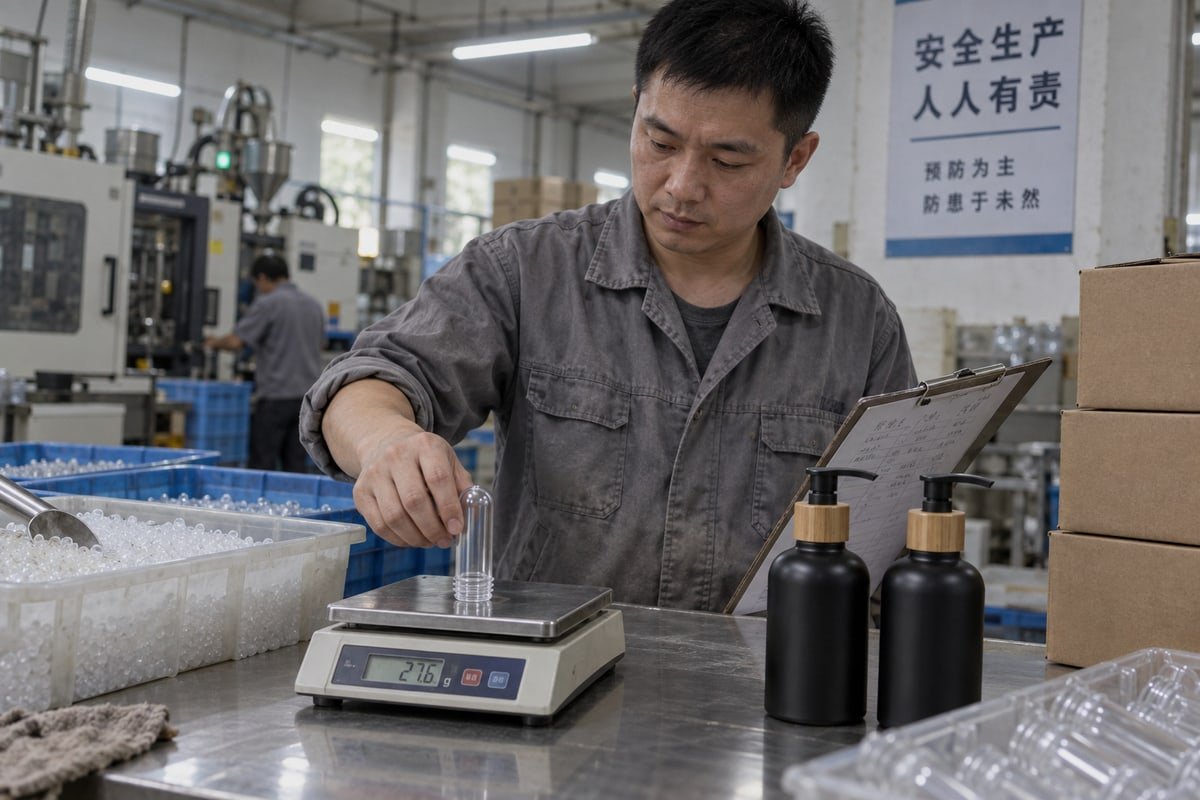
A PET bottle price is never one number. It is a stack of choices. When we prepare a quote for a custom skincare bottle, our production planner builds it from the bottom up. I recommend buyers read quotes the same way.
Start with the unit cost breakdown
Ask every supplier for a unit cost breakdown, not just a per-piece figure. The breakdown should show the bottle body, the closure or pump, decoration, and inner packing as separate lines. If one supplier bundles the pump and another leaves it out, the two numbers are not the same product. Our quotes always state whether closures and outer packaging are included. That is because we support customization of capacity, color, bottle material, and outer packaging, and each of those options changes the total.
Why preform weight moves the price
Two bottles can both say 100 ml and still cost very different amounts. The reason is preform weight. Resin is the largest cost input in a PET bottle. A heavier preform uses more resin and often runs slower on the line. A lighter one costs less but may feel flimsy or flex under a pump. Insist that every quote lists the gram weight, the resin grade, and the intrinsic viscosity 2 (IV) of the material. Without those three data points, you cannot verify technical equivalence.
Tooling and mold costs
Custom shapes need molds. Some suppliers amortize tooling and mold costs into the unit price. Others charge it up front. A third group charges nothing but keeps ownership of the mold. Each approach changes your true cost and your freedom to move later.
| Cost factor | What to ask for | Why it matters |
|---|---|---|
| Unit price | Price per bottle, per quantity tier, in one currency | Tiers reveal how MOQ changes economics |
| Preform weight and resin | Gram weight, resin grade, IV value, rPET share | Confirms you are pricing the same bottle |
| Neck finish specifications 3 | Neck standard and closure compatibility | Wrong neck means leaks or unusable caps |
| Tooling and mold costs | Charge, amortization, ownership | Hidden up-front or future relocation cost |
| Closure and decoration | Included or excluded, printing method | Turns a bottle body into a finished pack |
| Packaging | Case pack, pallet layout, export packing | Affects freight volume and damage risk |
| Logistics and freight terms | Incoterm and delivery point | Decides who pays freight, duty, and delivery |
| Resin price index | Adjustment formula and trigger | Controls price changes after signing |
One more line matters. Ask whether the supplier can supply the complete package, including pumps and decoration. If not, you must add a second supplier's cost and lead time to that quote before you compare it.
How can I make sure I'm comparing apples-to-apples quotes across different suppliers?
One trade-off I weigh on every RFQ is speed versus precision. A quick quote from a one-line inquiry is fast, but it almost never matches the competing offer.
To compare apples-to-apples, send every supplier the same RFQ template with fixed volume, gram weight, PET or rPET grade, neck finish specifications, closure, decoration, case pack, quantity tiers, delivery point, and Incoterm. Then log each reply in one matrix and re-quote any offer that deviates.

The fairest comparison starts before any quote arrives. It starts with the request. When a buyer sends us a vague inquiry, our sales team asks a list of questions before we price anything. When a buyer sends a full specification, we can quote in a day, and the buyer can line our number up against others without guessing.
Step-by-step: build the RFQ once, send it to everyone
- Fix the bottle. State the exact volume and tolerance, the target gram weight, the resin grade, and whether rPET content is required.
- Fix the neck. Write the neck finish specifications and the closure you plan to use. A pump, a disc cap, and a dropper each need a different neck.
- Fix the finish. Describe color, printing, labeling, or frosting. Attach artwork if you have it.
- Fix the pack-out. Give the case pack, the pallet standard, and export packing needs.
- Fix the volume. Give annual demand and the quantity tiers you want priced. Ask for MOQ in bottles, not cases.
- Fix the delivery. Name the destination, the Incoterm, and the target date.
- Fix the paperwork. List required certifications and testing, and state whether you want food-grade compliance documents tied to the actual production batch.
- Fix the definitions. Define lead time as the window from confirmed order to arrival at your dock, not just to ex-factory.
The comparison matrix
Once replies come in, put them in one table. Do not read them as emails. A matrix exposes gaps instantly.
| Matrix column | Supplier A | Supplier B | Supplier C |
|---|---|---|---|
| Quote reference and revision date | |||
| Exact spec quoted (volume, gram weight, neck, resin, IV) | |||
| Unit price and currency per tier | |||
| Minimum order quantity (MOQ) in bottles | |||
| Incoterm, origin, and delivery point | |||
| Tooling, sample, and testing charges | |||
| Packaging and palletizing cost | |||
| Lead time, order to dock | |||
| Payment terms and quote validity | |||
| Exclusions and assumptions | |||
| Certifications and test reports attached |
Some buyers with small orders tell me they do not need this. They just want the lowest number. I understand the instinct, but small orders are the most distorted by MOQ, pack size, and shipping basis. A single pallet quoted EXW versus DDP can swing more than the bottle price itself. The matrix takes twenty minutes. A wrong supplier choice takes months to unwind.
If a quote does not match the template, do not adjust it yourself. Send it back and ask the supplier to re-quote against your spec. That is standard practice for serious buyers now, and reliable factories expect it.
What hidden costs should I watch out for when reviewing PET bottle quotations?
A lesson from one Australian client still guides me: her cheapest quote from another factory arrived with leaking pumps, and return freight erased every saving.
Hidden costs in PET bottle quotations include excluded tooling and mold charges, sample and testing fees, export packing and palletizing, destination port charges, customs broker fees, duties and taxes, bank transfer fees, MOQ-driven inventory carrying costs, tooling ownership restrictions, and resin price index adjustments added after signing.

The number on the quote is the starting point. The number that hits your ledger is the landed cost 4 per usable bottle. Fair comparison means converting every offer to that same basis. Here is how we explain it to buyers who ask us for DDP terms into the United States, Germany, or Australia.
Convert every quote to landed cost
Take the product price. Add every cost between the factory floor and your warehouse shelf. Divide by the number of usable bottles you actually receive, after rejects. That is the only per-bottle figure worth ranking.
| Landed cost element | EXW quote | FOB quote | DDP quote |
|---|---|---|---|
| Product price | Included | Included | Included |
| Export packing and palletizing | Often extra | Usually included | Included |
| Inland transport to port | Buyer pays | Included | Included |
| Ocean or air freight | Buyer pays | Buyer pays | Included |
| Insurance | Buyer pays | Buyer pays | Usually included |
| Destination port charges | Buyer pays | Buyer pays | Included |
| Customs broker fees | Buyer pays | Buyer pays | Included |
| Duties and taxes | Buyer pays | Buyer pays | Included |
| Final delivery to warehouse | Buyer pays | Buyer pays | Included |
| Inspection or testing | Varies | Varies | Varies |
| Bank transfer fees | Buyer pays | Buyer pays | Buyer pays |
An EXW price will almost always look lowest. It simply moves the most cost onto you. When we quote DDP, our number is higher on the page, but the buyer knows exactly what she will pay when the pallets arrive.
Costs that hide in the contract, not the price
Some hidden costs never show up as a line item. Watch for these.
Tooling ownership. If the supplier keeps the mold, you may not be able to move production later. Ask who owns the tool, who pays for maintenance, and whether you can relocate it.
Resin price index clauses. Resin markets move. Many suppliers link price to a published resin price index. That is fair if the formula is transparent, both directions apply, and the trigger threshold is written down. It is unfair if the clause only allows increases or has no formula at all.
MOQ and carrying cost. A lower unit price at a huge MOQ is not a saving if the bottles sit in your warehouse for a year. Weigh minimum order quantity against your inventory carrying cost and your actual storage capacity.
Rejects and claims. This is the cost my Australian client learned about. Leaking pumps, wrong neck fit, or inconsistent weights create rework, returns, and lost launch dates. Ask how the supplier handles complaints and what remedy the quote promises.
Some buyers still argue that the lowest unit price should win because it cuts immediate spend. The trouble is that "immediate spend" is only a slice of the bill. The rest arrives later as freight invoices, duty, and returns. Total cost of ownership (TCO) is the fair measure, and every ranking page on this topic now agrees.
How do I balance price, quality, and lead time when choosing between PET bottle suppliers?
When a US procurement manager asked me on WhatsApp whether she should pick the fastest quote or the cleanest QC report, I told her to score both first.
Balance price, quality, and lead time by building a weighted scorecard: rank suppliers first on landed cost per usable bottle, then score quality assurance protocols, sample-to-production match, verified compliance, order-to-dock lead time reliability, capacity, and traceability. Choose the best total cost of ownership, not the lowest headline price.
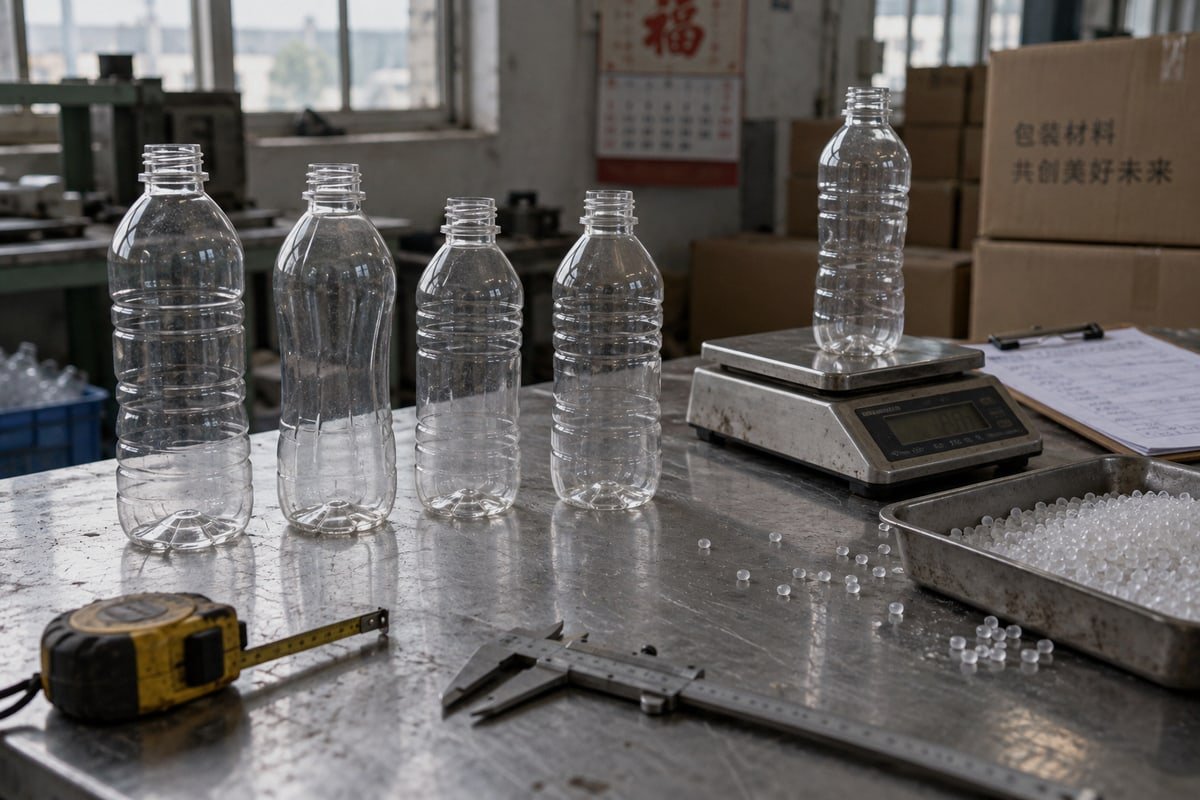
Price is easy to rank. Quality and lead time are harder because they are promises, not numbers. Still, you can turn them into scores. Here is the approach we suggest, and the same one we ask buyers to hold us to.
Build a weighted scorecard
Give each factor a weight that reflects your real risk. A brand launching a serum with a tight retail date should weight lead time heavily. A brand with a long shelf program can lean on price. Then score each supplier on every factor using the evidence they sent, not their sales pitch.
| Factor | Evidence to request | Suggested weight |
|---|---|---|
| Landed cost per usable bottle | Your own landed cost calculation | High |
| Quality assurance protocols | Inspection plan, weight and leak checks, AQL levels | High |
| Sample-to-production match | Golden sample sign-off, first-article report | High |
| Verified compliance | Food-grade compliance certificates tied to the facility and batch, independently checked | Medium to high |
| Lead time reliability | Order-to-dock definition, on-time history, capacity statement | Medium to high |
| Traceability and change control | Batch coding, written change-notice process | Medium |
| Sustainability data | Carbon footprint per unit, rPET share | Medium, rising |
| Complaint handling and remedy | Written claim process and replacement terms | Medium |
Two points deserve extra care. First, do not accept certificates at face value. Ask for the certificate number and confirm it with the issuing body. Make sure it covers the plant that will make your bottle, not a sister site. Second, define lead time the same way for everyone. One supplier's "15 days" may mean ex-factory. Another's "30 days" may mean at your dock. Only the second one is useful to your planner.
Where quality belongs in the comparison
Some procurement teams evaluate quality after they shortlist on price. I think that order is backwards. If a bottle fails closure fit or has inconsistent weight, the true cost climbs through rejects, delays, and claims. On our own line, the leak test on pump bottles happens before anything is packed, precisely because a leak found at the customer's warehouse costs far more than a leak found on our bench. Quality risk belongs inside the quote comparison, not after it.
Newer factors worth a column
Buyers in Germany and Australia now ask us about three things that did not appear on scorecards a few years ago. Lightweighting: some suppliers can simulate a lighter bottle with a digital twin and show the strength-to-weight trade-off before cutting steel. Carbon footprint per unit: brands with Scope 3 targets want an embedded carbon figure for the bottle, not just a recycling claim. Digital traceability: with Digital Product Passport mandates approaching in Europe, ask whether the supplier can attach batch-level data to each production lot. None of these replace price. All of them separate a supplier who will still fit your needs in three years from one who will not.
When the higher quote is the better deal
Sometimes the second-lowest quote wins. That happens when it includes DDP delivery, a signed-off golden sample, verified food-contact documents 5, and a realistic dock date. The lowest quote may be cheaper by a few cents a bottle and still cost more once you add the pieces it left out. Fairness is not about favoring the expensive supplier. It is about making sure the cheap one is really cheap.
Conclusion
Unmatched PET bottle quotes hide cost and risk. Normalize the spec, convert to landed cost, then score quality and lead time. Send me your RFQ and we'll quote that way.
Footnotes
1. The International Trade Centre provides global trade intelligence and support for procurement and supply chain management. ↩︎
2. Scientific definition of intrinsic viscosity, used to characterize the molecular weight and flow properties of PET. ↩︎
3. The International Society of Beverage Technologists sets technical standards for plastic bottle neck and thread finishes. ↩︎
4. Official U.S. government portal for trade information, including guidance on calculating total export and import costs. ↩︎
5. FDA resources for ensuring materials used in food packaging meet safety and regulatory compliance standards. ↩︎
