
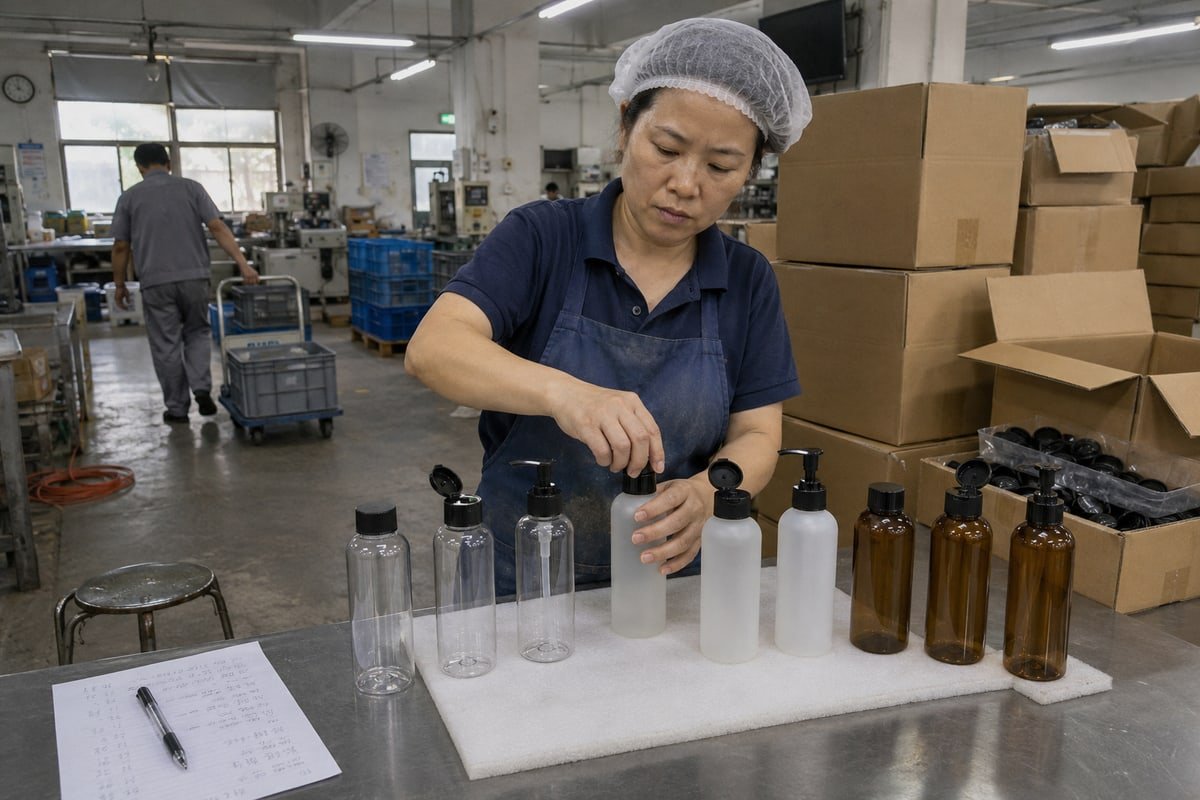
A leaking bottle can sink a product launch. On our Taizhou production line 1, we have watched mismatched caps ruin entire shipments. Choosing the same supplier for PET bottles and caps matters.
Yes, in most cases you should use the same supplier for PET bottles and caps. Single-source procurement guarantees neck finish compatibility, reduces leakage risk, simplifies quality control, and consolidates shipping. However, separate specialized suppliers can win on cap innovation, pricing leverage, and unique closure technology.
The real question is not simply one supplier or two quality control standards 2. It is which sourcing model protects your product, your timeline, and your budget. I will walk through each angle below. By the end, you will have a clear packaging procurement framework you can apply to your next order.
Will Sourcing Bottles and Caps from the Same Supplier Reduce My Risk of Leakage Issues?
Last year, a skincare buyer came to us after an entire shipment of leaking lotion bottles was returned. Her bottles and caps had come from two different factories. That failure was preventable.
Yes, sourcing bottles and caps from the same supplier significantly reduces leakage risk. One factory controls both neck finish specifications and closure dimensions, tests them as a matched system, and takes full accountability when seals fail, eliminating the finger-pointing common with split sourcing.
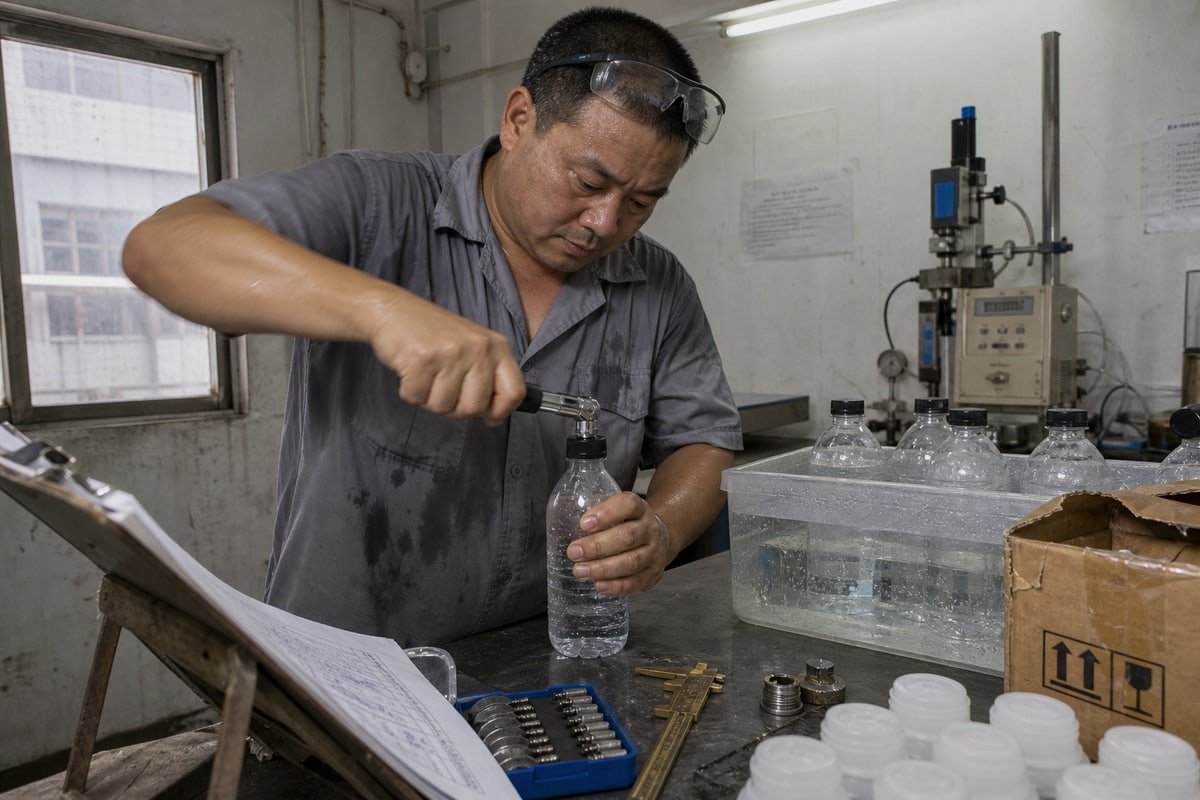
Leakage prevention starts long before filling. It starts at the mold. When one factory handles both preform manufacturing 3 and cap injection molding, the two parts are engineered as a single sealed system. When two factories are involved, each part may pass its own inspection and still fail when assembled.
Where Leaks Actually Start
Most leaks come from small dimensional gaps, not obvious defects. A thread that is a fraction of a millimeter off can pass a visual check and still let serum weep out during air freight. Here are the failure modes we test for on every cosmetic packaging order.
| Failure Mode | Root Cause | Split Sourcing Outcome | Same Supplier Outcome |
|---|---|---|---|
| Slow seep at the thread | Thread dimensions mismatched | Each factory blames the other | One team corrects the mold |
| Cap backs off in transit | Wrong torque spec for the liner | No shared torque standard | Torque tested on the real pair |
| Cracked neck under load | Neck wall too thin for cap force | Discovered after assembly | Caught in joint fit-up testing |
| Visible color mismatch | Pigments vary between resin batches | Two separate color standards | One batch, one material consistency check |
One Point of Accountability
The accountability difference is just as important as the engineering. When a sealing failure happens with split sourcing, you become the referee between two vendors. With single sourcing, one supplier owns the fix. In our experience, that alone can shorten a defect resolution from weeks of emails to a single corrective action report. Closure compatibility stops being your problem and becomes your supplier's contractual duty.
How Can I Ensure a Perfect Fit Between My PET Bottles and Caps When Using Different Suppliers?
One procurement manager from Australia messaged me on WhatsApp with a simple question: could our caps fit bottles she already stocked? The honest answer required careful spec matching first.
To ensure a perfect fit across suppliers, share exact neck finish specifications with both parties, confirm thread dimensions and liner type, request golden samples, run torque and leak testing on assembled units, and lock all measurements into a signed technical drawing before mass production.
Cross-supplier fit is achievable. We help buyers do it regularly when they have an existing cap they love. But it only works when you treat compatibility as a documented process, not a hopeful assumption. Here is the exact sequence we follow at our factory.
- Confirm the neck finish code. Common cosmetic finishes like 24-410 or 28-410 describe diameter and thread style. Both suppliers must reference the same standard, not just a similar-looking size.
- Exchange full technical drawings. A finish code alone is not enough. Request the complete dimensional sheet from each supplier and compare them line by line.
- Verify the critical dimensions. The table below shows what we measure with calipers and thread gauges on every incoming sample.
- Assemble and test golden samples. Apply the cap at the specified torque, then run leak tests, drop tests, and a transit simulation before approving anything.
- Lock the drawing into your purchase order. Once both parts pass, the signed drawing becomes your quality control reference for every future batch.
Key Thread Dimensions to Confirm
| Dimension | What It Controls | Risk If Mismatched |
|---|---|---|
| T (thread outer diameter) | How the cap grips the neck | Loose caps, stripped threads |
| E (thread root diameter) | Thread depth engagement | Weak torque retention |
| I (inner bore) | Fit of plugs and orifice reducers | Poor inner seal, leaks |
| H (neck height) | Liner compression distance | Gaps between liner and land |
Skip any step, and close enough becomes your specification. In packaging, close enough is how returns happen.
Will Combining My Bottle and Cap Orders with One Supplier Speed Up My Shipping and Reduce Delays?
Delays cost more than freight. Over years of exporting to the United States, Germany, and Australia, we have learned that split shipments create the worst waiting games for buyers.
Yes, combining bottle and cap orders with one supplier typically speeds delivery. You get one consolidated shipment, one customs clearance, synchronized lead times, and no risk of production stalling because caps arrived weeks after bottles. Freight costs also drop through container consolidation.
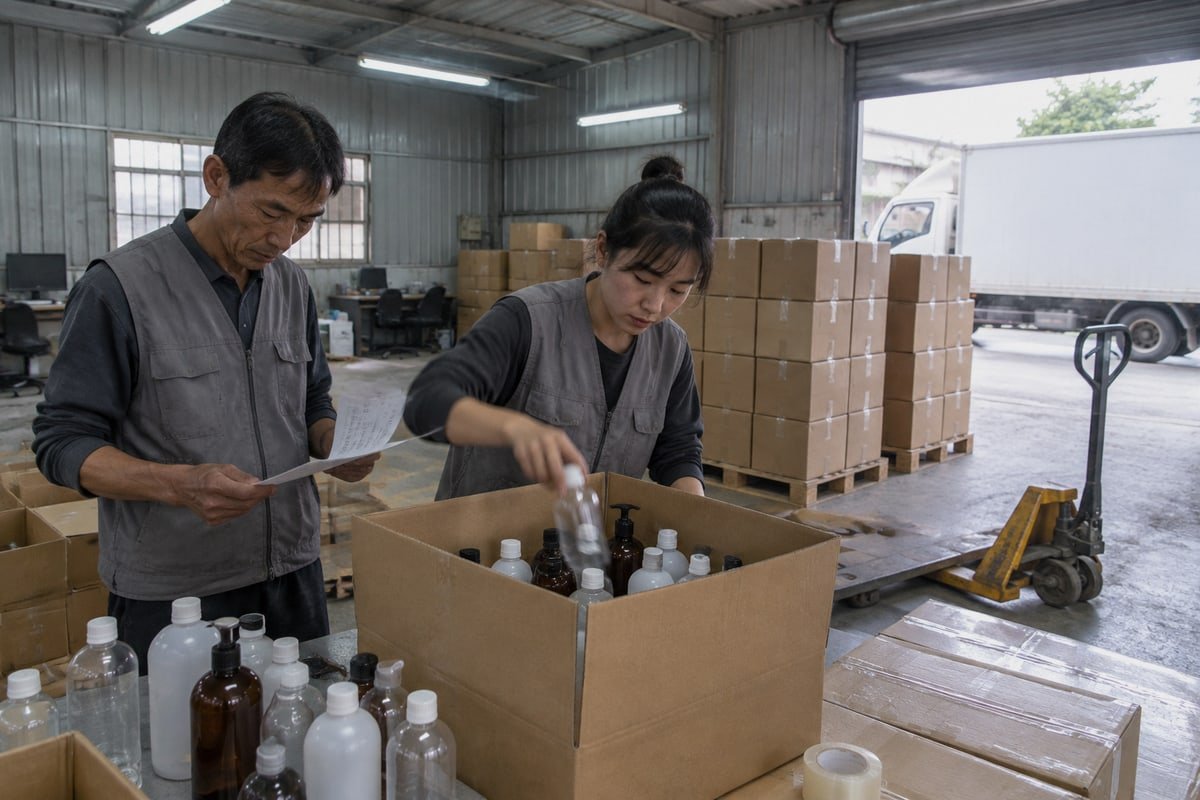
Shipping speed is really about synchronization, not distance. Your filling line needs both components on the same day. If bottles arrive on time but caps sit in a second container three weeks behind, your effective lead time is set by the slower vendor. That is the core weakness of split sourcing, and it is where supply chain optimization pays off most visibly.
Single Shipment vs Split Shipments
| Factor | Same Supplier | Two Suppliers |
|---|---|---|
| Lead time management | One synchronized schedule | Two schedules to chase |
| Customs clearance | One entry, one set of documents | Two entries, double paperwork |
| Freight cost | One consolidated container | Two part-loads, higher cost per unit |
| Invoicing | Single invoice, simpler accounting | Two invoices, two payment terms |
| Inventory logistics | Balanced stock arrives together | Bottles without caps tie up warehouse space |
| Delay exposure | One vendor to monitor | Slowest vendor gates everything |
The Hidden Cost of Inventory Imbalance
There is a quieter cost buyers often miss. When components arrive out of sync, you pay to store bottles you cannot fill. We ship DDP for many of our clients precisely because they want one delivery, one clearance, and zero coordination burden. One buyer told me her previous split arrangement left a pallet of capless bottles in her Melbourne warehouse for a month. That is rent paid on plastic that earns nothing. Consolidation removes that entire category of waste.
Am I Taking on Too Much Risk If I Rely on a Single Supplier for Both My Bottles and Caps?
Concentration risk is real, and we tell buyers this ourselves, even though consolidation benefits our factory. The honest answer depends on your supplier's depth, not the sourcing model alone.
Relying on a single supplier for bottles and caps carries manageable risk if you vet properly. Mitigate exposure by auditing production capacity, requiring quality control standards in writing, holding safety stock, and pre-qualifying a backup supplier. For most brands, compatibility benefits outweigh concentration risk.

Let me address the three strongest objections to single-source procurement head-on, because each one deserves a real answer, not a sales pitch.
Objection one: I lose pricing leverage. Partly true. With one vendor, you cannot play quotes against each other line by line. But you can still benchmark. Request itemized pricing for bottles and caps separately, then compare each line against the open market annually. If your integrated supplier cannot stay within a reasonable band of best-in-class pricing, renegotiate or requalify. Leverage comes from information, not from splitting orders.
Objection two: specialized closure suppliers innovate faster. Sometimes true. If your product needs a patented airless pump or a niche dispensing system, a dedicated closure house may lead. In that case, split sourcing is justified, but only with the full compatibility process from the section above. For standard flip-tops, disc caps, and screw closures used across skincare, an integrated supplier engineering the neck and closure together can actually lightweight the whole interface more aggressively without sacrificing seal integrity.
Objection three: mono-material claims are overhyped. This one has teeth. All-PET bottle-and-cap systems simplify recycling because mixed PET bottles with PP or HDPE caps complicate sorting at recovery facilities. But PET caps can run heavier and slower to mold than polyolefin caps, and where deposit-return systems drive high bottle collection rates, cap material matters less than cap retention. The EU's tethered cap rules 4 for beverage containers, in force since July 2024, show how regulation is pushing bottle and cap toward one engineered system. A single supplier also gives you one consolidated PCR content and carbon footprint calculation for sustainability reporting, and one reliable platform if you later add NFC tags or digital watermarking.
A Simple Decision Framework
| Your Priority | Best Sourcing Model |
|---|---|
| Leakage prevention and fast troubleshooting | Same supplier |
| Standard closures at competitive cost | Same supplier, benchmarked yearly |
| Patented or specialized dispensing technology | Split sourcing with documented spec matching |
| Mono-material recyclability claims | Same supplier with all-PET capability |
| Maximum negotiating leverage above all else | Split sourcing, accept coordination cost |
Conclusion
Mismatched packaging quietly kills margins through leaks, delays, and returns. For most brands, one proven supplier for PET bottles and caps is the safer, faster, simpler path.
Footnotes
1. Wikipedia entry explaining the history and operation of assembly lines in modern manufacturing environments. ↩︎
2. The International Organization for Standardization’s overview of quality management systems and industrial compliance standards. ↩︎
3. Wikipedia page detailing the properties and production methods of Polyethylene terephthalate used in plastic packaging. ↩︎
4. Official European Union resource explaining environmental directives and requirements for tethered closures on plastic bottles. ↩︎
