
To make the product highlight personalized, therefore, most of the molding packaging products need to be surface coloring treatment, daily packaging surface treatment processes are diverse, such as vacuum coating, spraying, electroplating, anodizing, injection molding, and other processes. In this article, we briefly describe the anodizing process, only for you to purchase the following basic understanding:
Process definition:
Anodizing process refers to the metal or alloy parts as the anode, using the method of electrolysis to form an oxide film on its surface. The metal oxide film changes the surface state and performance, such as surface coloring, improving corrosion resistance, enhancing wear resistance and hardness, and protecting the metal surface.
Process characteristic:
The anodic oxidation process can increase the corrosion resistance, hardness, and wear resistance of the product (the hardness of the aluminum matrix is HV100, the hardness of the ordinary anodic oxide film is about HV300, and the hard oxide film can reach HV500), decorative, not only to protect the luster of the polished surface but also to stain and color, to obtain and maintain a colorful appearance, electrical insulation, transparency, and functionality.
System composition:
1, Anodizing equipment:
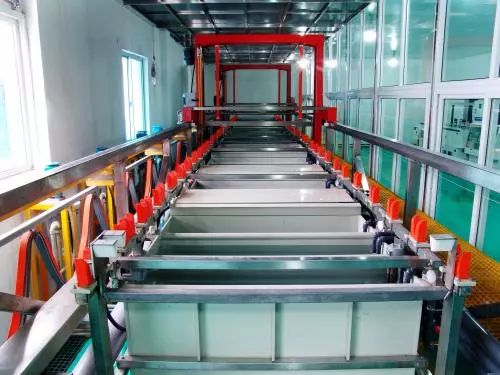
2, Aluminum material :

The chemical properties of aluminum are active, and a dense oxide film about 5nm thick is formed immediately on the surface of aluminum in dry air, so that aluminum will not be further oxidized and can withstand water; the Aluminum powder is easily explosive when mixed with air; Molten aluminum can react violently with water, and many metal oxides can be reduced to corresponding metals at high temperatures; Aluminum is amphoteric, soluble in both strong bases and dilute acids. Aluminum has good corrosion resistance in the atmosphere. Still, the strength of pure aluminum is low, and various aluminum alloys that can be used as structural materials can be obtained only by alloying.
3. Oxide film
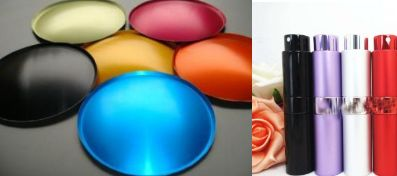
The oxide film is produced after the oxidation treatment of aluminum and its alloys. High porosity, strong adsorption capacity, easy to stain. The dyeing method puts the anodized parts into an aqueous solution of organic dyes for dyeing or electrolytic coloring.
Process flow
- Flow Chart

2. Relevant instructions
Aluminum material:
The outstanding characteristics of aluminum alloy are low density and high strength. Aluminum has a density of 2.7g/cm3. High plasticity (good ductility of aluminum and aluminum alloy, can be squeezed and rolled into various types of materials), good conductivity (second only to gold, silver, and copper), corrosion resistance (easy to form an oxide film with good corrosion resistance, generally does not react in the air), easy surface treatment (such as anodizing, electroplating, electrophoresis, spraying, etc., improve the decorative and protective effect of aluminum)
Degrease:
Remove the oil and impurities on the surface of the processed products and the scratches on the surface of the products, metal hairings, metal oxides, etc., to lay a good foundation for anodic oxidation coloring, so that its luster can meet the requirements of customers.
Chemical polishing:
It is to soak the workpiece in a phosphoric acid-based solution to eliminate the mechanical defects on the surface of the workpiece, reduce the surface roughness, and improve the surface luster.
Anodizing:
The principle of anodizing aluminum is essentially the principle of water electrolysis. When an electric current passes through, hydrogen gas is released on the cathode; On the anode, the oxygen precipitated is not only molecular oxygen but also atomic oxygen (O) and ionic oxygen, usually expressed as molecular oxygen in the reaction. The aluminum as the anode is oxidized by the oxygen precipitated on it to form an anhydrous alumina film, and the generated oxygen is not all of the action with aluminum, and some of it is precipitated in the form of a gaseous state.
After anodizing, before coloring, the oxide film can be activated by acid treatment, and all organic/inorganic acids and acidic salts can be used as activators. Due to the chemical dissolution of the acid solution on alumina, the pore wall of the oxide film hole is dissolved from the outside to the inside, so that the pore size is enlarged. At the same time, alumina film with different pore sizes can be obtained by controlling the length of activation time. Increase the porosity, thereby improving the effect of adsorbing dyes.
Dye:
The chemical coloring of the anodized aluminum film is based on the ability of the porous film to adsorb dyes like textile fibers. Generally, the pore diameter of the anodic oxide film is 0.01-0.03μm, while the dye is separated into a single molecule in water, with a diameter of 0.0015-0.0030μm. When coloring, the dye is adsorbed on the pore surface and diffused into the hole, accumulated, and combined with aluminum oxide for ionic bonding and hydrogen bonding to color the film layer. After sealing treatment, the dye is fixed in the pores.
Hole sealing:
It is an integral part of the dyeing process to seal the micropores of the anodic oxide film and fix the dye in the micropores. The simplest sealing treatment is to treat in boiling water, as long as it is properly carried out, it can ensure that the dyed film shows the due color firmness, and it can also make the workpiece the ability to prevent grease printing, stains, and grease. The anodized surface can only be sufficiently sealed so that it loses its ability to affect the contact.
Cosmetic packaging application:
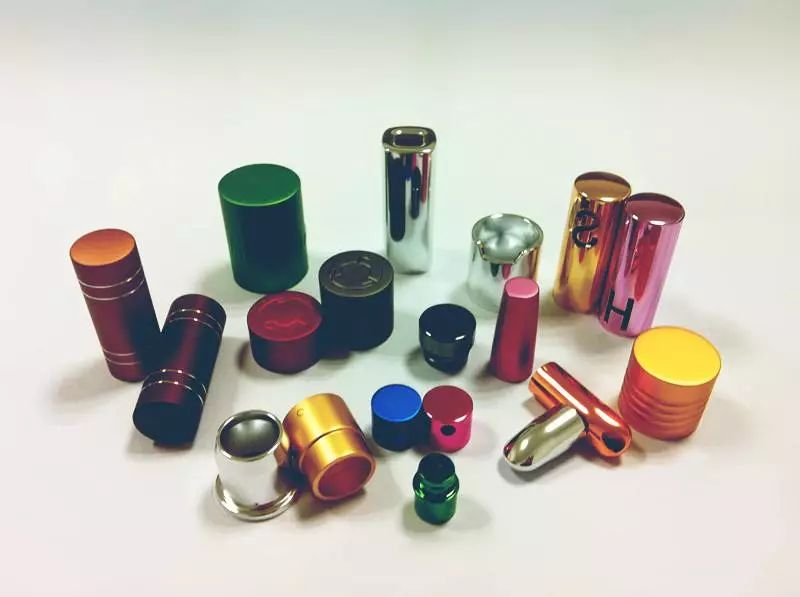
In cosmetic packaging materials, metal accessories are often used as external components of the product. Such as the metal components of the lipstick tube, makeup tool components, the outer components of the bottle cap, etc., the oxidation process not only increases the beauty of the metal components but also protects the time tolerance of the metal components.
