
The PET bottle is based on PET plastic material, plastic containers are obtained by one-step or two-step processing. PET plastic has the characteristics of being lightweight, having high transparency, impact resistance, and not being easy to break.
Part One: Manufacturing Process
- Know the Preform
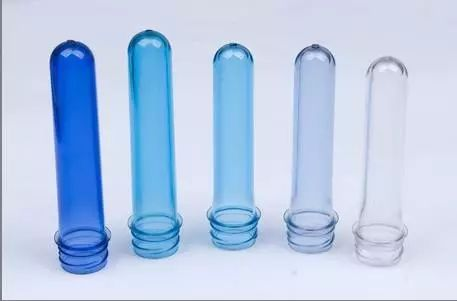
A preform is an injection molded item. As the intermediate semi-finished product of subsequent biaxial stretch blow molding, the bottleneck of the preform has been finalized in the stage of injection molding, and its size will not change during heating and stretching/blowing. The design of the size, weight, and wall thickness of the preform is Factors that we need to pay great attention to when blowing bottles.
2. PET bottle Formation
There are two methods to make PET containers.
A. ONE-STEP method
The process of completing the injection, drawing, and blowing in one machine is called the one-step method. The one-step method is to do stretching and blowing after the preform is cooled after injection molding. Its main advantages are power saving, high productivity, no manual work, and less pollution.
B. TWO-STEP method
The two-step method separates injection and stretch-blowing and performs time-sharing on two machines, which is also called the injection stretch-blowing process. The first step is to inject the preform with an injection molding machine. In the second step, after the preform at room temperature is reheated, it is blown into a bottle. The advantage of the two-step method is that the preform is purchased for blow molding, reducing investment (manpower and equipment). The volume of the preform is much smaller than the bottle, which is convenient for transportation and storage. The preforms produced in the off-season can be blown into bottles in the peak season.
C. PET bottle Forming Process

- Stretch Rod stretch; 2. Pre-blowing air intake; 3. Pre-blow to get shape;4. High-pressure gas enters and keeps pressure; 5. Stretch rod blew to cool (hot fill only); 6. Exhaust
Part Two: Material and Structure
1. PET Material
PET, polyethylene terephthalate, referred to as polyester, is produced by the polymerization reaction (polycondensation) of two chemical raw materials, PTA (terephthalic acid) and ethylene glycol (ethylene glycol).
2. Bottle Neck Finish
There are Ф18, Ф20, Ф22, Ф24, Ф28, Ф33, and other diameters (corresponding to the T size of the bottle mouth) through the bottle mouth. The thread specifications can usually be divided into 400, 410, and 415 (corresponding to the number of thread turns). 400 is 1 turn thread, 410 is 1.5 turn thread, and 415 is a 2-turn thread.

Part Three: Purchasing Notes
- Available materials for bottle blowing, PET is just one of them, there are also PE blow bottles (softer with more solid colors, one-time forming), PP blow bottles (harder with more solid colors, one-time forming), PETG blow bottles (transparency ratio PET is even better, but not commonly used in China, high cost, high cost, one-time forming, non-recyclable materials), PVC blowing (harder, not environmentally friendly, transparency is worse than PET, but better than PP and PE brightness).
- PET bottle molds are less expensive.
