

Last spring, a buyer sent me a rival PET bottle supplier’s mold quote. It was double what our Taizhou factory charges. Mold-making costs confuse buyers, and confusion costs money.
To negotiate mold-making costs with PET bottle suppliers, request an itemized tooling quote, benchmark it against published mold price ranges, separate tooling from unit price, secure written mold ownership, and trade volume commitments for tooling amortization across your first production runs.
That is the short version. The long version matters more. A mold is not a one-time fee. It is an asset that shapes your unit price 1, your lead time, and your quality for years. Below, I walk through how we price tooling on our own production line, and how you can use that structure to get a better deal.
How can I tell if a PET bottle supplier's mold quote is fair or inflated?
Two years ago our engineers inspected a 100 ml PET lotion bottle mold a client had bought elsewhere. The steel was fine. The original quote had simply been padded.
A PET bottle mold quote is fair when it matches published ranges for its cavity count, steel grade, and runner type, itemizes design, sampling, and trial runs, and states mold life expectancy. Quotes far above those benchmarks without extra scope are inflated.

The first thing to understand is that "PET bottle mold" means several different things. A preform mold for Injection Stretch Blow Molding 2 is a heavy injection tool. A blow mold for the finished bottle shape is a lighter tool. A prototype tool is lighter still. Suppliers often quote one of these and buyers compare it to another. That is where most confusion starts.
Start with published benchmarks
Several pricing guides publish ranges. I use them as anchors, not as truth. Here is what they show.
| Mold type | Published price range | Typical use |
|---|---|---|
| Simple custom tooling on marketplace listings | $800–$3,000 | Small variations on a standard shape |
| Custom mold development (supplier guide) | $2,000–$15,000 | Custom cosmetic bottle shapes |
| Single-cavity aluminum prototype mold | $4,200–$7,800 | Sampling and low-volume runs |
| Single-cavity cold-runner PET preform mold | $18,500–$24,000 | Preform injection |
| Multi-cavity steel production mold | $18,500–$42,000 | Volume production |
| Single-cavity standard water preform mold | $26,500–$31,000 | High-output water preforms |
The ranges overlap because they describe different products and different regions. So before you judge a quote, ask what the mold actually is. Then compare it to the right row.
Check the drivers behind the number
Once you know the mold type, look at four cost drivers. First, cavity count. A multi-cavity mold design costs more steel and more machining. Second, steel grade. P20 or S136 steel suits high-volume durability. Aluminum suits prototypes and short runs. Mold life expectancy follows the material. Third, runner type. A hot runner adds cost but cuts waste. Fourth, geometry. Thin walls, heavy shoulders, or a decorative diamond-cut surface all raise machining and polishing time.
Three questions that expose padding
At our factory we put steel grade and cavity count 3 on the first page of every quote. If a supplier will not do that, ask three questions. What is the mold life in shots? Are design revisions and trial runs included? Did you run a mold flow simulation before cutting steel? A digital twin study costs little and prevents repeated physical trials. A supplier who skips it and bills you for three sampling rounds is not saving you money.
If a quote sits far above the benchmark row and none of these drivers explain the gap, it is inflated. If it sits below the row, ask what was left out.
What mold cost components should I negotiate separately to save money?
Every quote we prepare forces one choice: bundle everything into one tooling number, or split it out. Bundling looks simpler. Splitting gives the buyer more to negotiate.
Negotiate these mold cost components separately: mold base and inserts, cavity count, steel grade, hot or cold runner, cooling design, prototyping and sampling costs, design revisions, trial runs, and maintenance. Separating them exposes margin padding and lets you drop what you do not need.
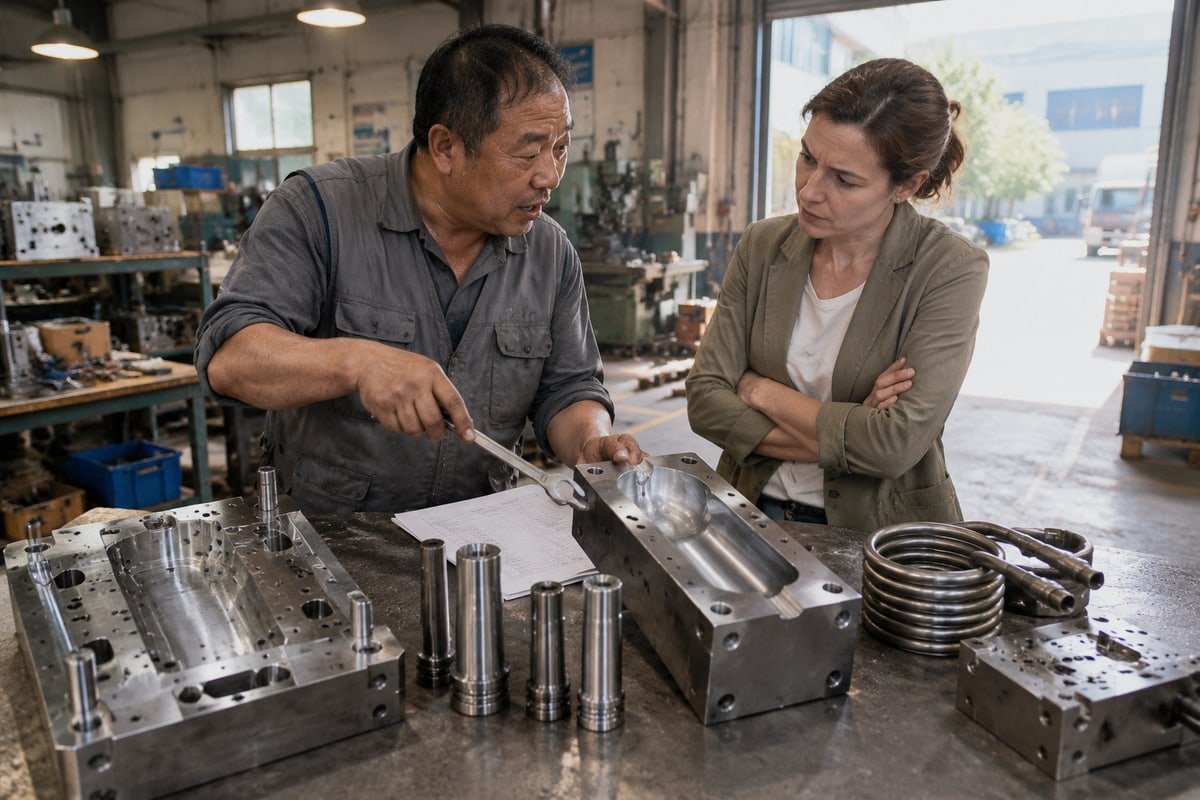
A single tooling number hides where the money goes. When we break our quotes apart for skincare brands in the United States and Germany, the conversation changes. The buyer stops arguing about the total. They start choosing.
| Component | What to ask the supplier | Your negotiation lever |
|---|---|---|
| Mold base | Is it universal or dedicated to this bottle? | Request modular tooling and pay only for inserts |
| Cavity count | What volume justifies each cavity? | Cavity count optimization against your real forecast |
| Steel grade | P20, S136, or aluminum? | Match steel to expected shots, not to the maximum |
| Runner system | Hot or cold runner? | Cold runner for lower volumes, hot runner for cycle time efficiency |
| Cooling channels | Conventional or conformal cooling? | Faster cycles justify a lower unit price |
| Prototyping and sampling costs | How many sample rounds are included? | Replace physical trials with mold flow simulation |
| Design revisions | How many are free? | Fix revisions before steel is cut |
| Maintenance | Who replaces neck rings and worn parts? | Supplier absorbs routine refurbishment |
Modular tooling and cavity count
A modular approach is the biggest single saver for cosmetic brands. You pay once for a universal mold base. Then you buy inserts for each bottle size. A 30 ml serum bottle and a 100 ml lotion bottle can share one base. That cuts both cost and lead time on the second product.
Cavity count deserves its own discussion. More cavities raise tooling cost but lower the cost per thousand bottles. The mistake is to buy eight cavities for a product that sells two hundred thousand units a year. Ask the supplier to show the crossover point. Then pick the count your forecast supports.
Cooling, cycle time, and resin
Conformal cooling channels follow the bottle shape. They cut cycle time. Faster cycles mean the supplier makes more bottles per hour on the same machine. That throughput gain belongs partly to you. Ask for it as a lower unit price.
Two smaller items also matter. Preform weight optimization reduces resin per bottle, but it changes the preform mold, so settle it before machining starts. And if you plan to use recycled resin 4, rPET readiness matters. Recycled PET melts and flows differently. A mold built with proper venting and cooling for rPET avoids a costly rework later.
Geometry and maintenance
Simplify what you can. A smooth cylinder with rounded shoulders, like the matte black pump bottles we run for a lot of skincare clients, needs less CNC time and less hand polishing than a faceted surface. Save the complexity for where it sells.
Finally, negotiate a written mold maintenance schedule. Neck rings, stripper plates, and cooling seals wear first. In our contracts the supplier side handles routine refurbishment. Make sure yours does too.
How can I avoid hidden fees when negotiating mold-making costs with my supplier?
A procurement manager in Melbourne once messaged our sales team on WhatsApp at midnight. Her previous supplier had just added a storage fee for a mold she believed she owned.
Avoid hidden fees when negotiating mold-making costs with your supplier by demanding an itemized quote that states mold ownership, storage, maintenance, sampling, revision, shipping, duty, and packaging terms in writing, with a fixed payment schedule tied to approved milestones rather than open-ended invoices.
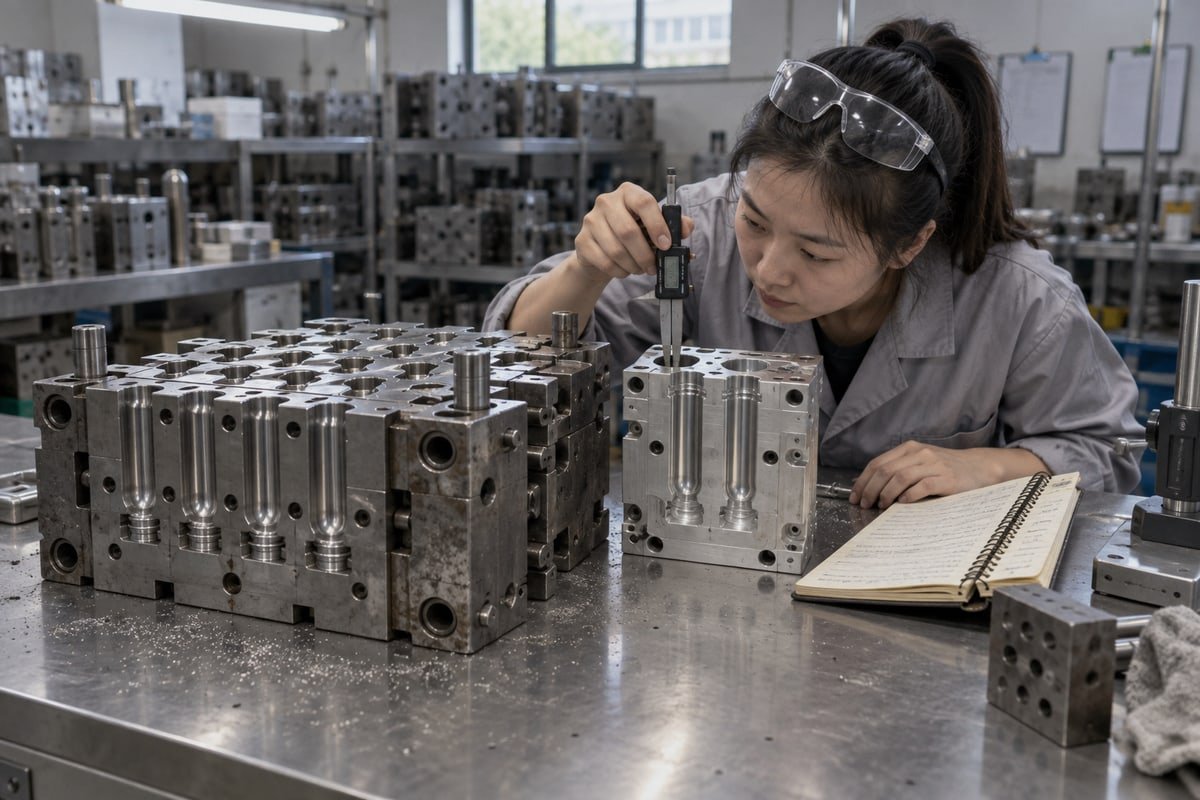
Hidden fees rarely look like fraud. They look like reasonable line items that appear after you have already paid the deposit. By then you have no leverage. So the work has to happen before the first payment.
Where the extra charges hide
| Hidden fee | How it usually appears | How to block it |
|---|---|---|
| Mold storage | Monthly charge after production pauses | State free storage while the mold is active in the contract |
| Extra sampling rounds | Per-round invoice after the included samples | Fix the number of included rounds and the cost of any extra round |
| Design revisions | Engineering hours billed after approval | Cap revisions before steel is cut, and freeze the drawing |
| Mold repair | Billed after a set number of cycles | Assign wear parts to the supplier in the mold maintenance schedule |
| Shipping and duty | Excluded from the unit price | Ask for DDP pricing to your warehouse |
| Rush tooling | Surcharge when lead time for tooling slips | Set the tooling lead time and a penalty for missing it |
The Right to Relocate clause
Ownership is the fee that costs the most. If the contract does not say you own the mold, the supplier does. That means you cannot move production if quality falls or prices rise. Ask for a Right to Relocate clause. It should say three things. You own the physical mold. You own the design files and drawings. The supplier will release both within a set number of days after your written request. When our factory builds a tool that the buyer has paid for in full, that clause goes in without argument. A supplier who resists it is telling you something.
Milestone payments and quality terms
Tie every payment to something you can check. A common structure is a deposit at drawing approval, a second payment at first-shot samples, and the balance at approved pre-production samples. No invoice should arrive without a milestone behind it.
Quality terms belong in the same document. The Melbourne buyer I mentioned had also lost a full shipment to leaking pumps. So define your quality assurance standards 5 in the tooling contract, not only in the purchase order. Set the AQL level, the leak test method, and the wall thickness tolerance. Then the sample approval milestone has teeth.
Add all of this up and you get the real number. That is the total cost of ownership. Tooling, samples, maintenance, storage, freight, duty, and the cost of defects. Compare suppliers on that figure. Never on the mold price alone.
Can I negotiate lower mold costs by committing to larger order volumes?
The hardest lesson I learned in my first year selling our factory's packaging was this: a big volume promise is only worth something when it is written into the contract.
Yes. Larger order volumes let suppliers amortize tooling over more units, so most will lower the upfront mold fee, waive it above a threshold, or spread it across early production runs. The concession must be tied to a written volume commitment with clear timing.

Volume is the strongest lever you have. It works because of simple arithmetic. A mold costs the same whether it makes one hundred thousand bottles or two million. The more bottles it makes, the less each one carries. Here is the math using a mid-range production mold price from the benchmark table.
| Mold cost | Bottles produced | Tooling cost per bottle |
|---|---|---|
| $30,000 | 100,000 | $0.30 |
| $30,000 | 500,000 | $0.06 |
| $30,000 | 2,000,000 | $0.015 |
Set that against finished PET bottle prices. Published benchmarks show simple bottles around $0.03 at very high volume, common ranges of $0.05 to $0.10, and $0.30 or more for complex designs. At low volume, the mold can cost more per bottle than the bottle itself. At high volume, it almost disappears. A supplier knows this. So a real volume commitment gives them room to move on the upfront fee.
How to structure the deal
- Bring a written forecast for twelve to twenty-four months, split by quarter.
- Ask for three options: full tooling paid upfront with ownership, tooling spread across the first three production runs, or tooling waived above a volume threshold.
- Agree on what happens if you miss the volume. A fair term is that the unpaid tooling balance becomes due, not that ownership reverts.
- Lock the unit price for the commitment period, with a resin index clause if the supplier insists.
- Write ownership and relocation rights into the same agreement.
Three objections I hear, and how I answer them
"I am a small brand with uncertain demand, so I want the lowest upfront fee." I understand that. But an underbuilt mold raises defect rates and slows cycles. The better path is a single-cavity aluminum prototype tool first, then a production tool once sales prove out. That keeps the first check small without locking you into weak steel.
"The supplier wants to keep the mold if they discount it." That is a fair trade only if it is time-limited. Agree that ownership transfers to you once the committed volume is reached or the tooling balance is paid. Do not accept permanent supplier ownership for a partial discount.
"A long contract removes my flexibility." It does, a little. But it also gives you price stability and priority on the machine schedule during peak seasons. Tiered pricing with an annual forecast review keeps most of the flexibility and most of the savings.
Tooling amortization is the frame that ties all of this together. Negotiate the mold as an asset that pays back over units. Not as a fee.
Conclusion
A padded mold quote drains cash. An unclear one drains it slowly. Itemize, benchmark, own the tool, and trade volume for amortization. Negotiate the whole production system, not the mold.
Footnotes
1. Authoritative resource for international trade regulations, pricing, and commercial documentation. ↩︎
2. Technical definition of the manufacturing process used for producing PET bottles from preforms. ↩︎
3. Reference for the various types of tool steel used in industrial mold manufacturing. ↩︎
4. Government resource for standards and strategies regarding the use of recycled plastic materials. ↩︎
5. Official source for international quality management standards applicable to manufacturing and procurement. ↩︎
