
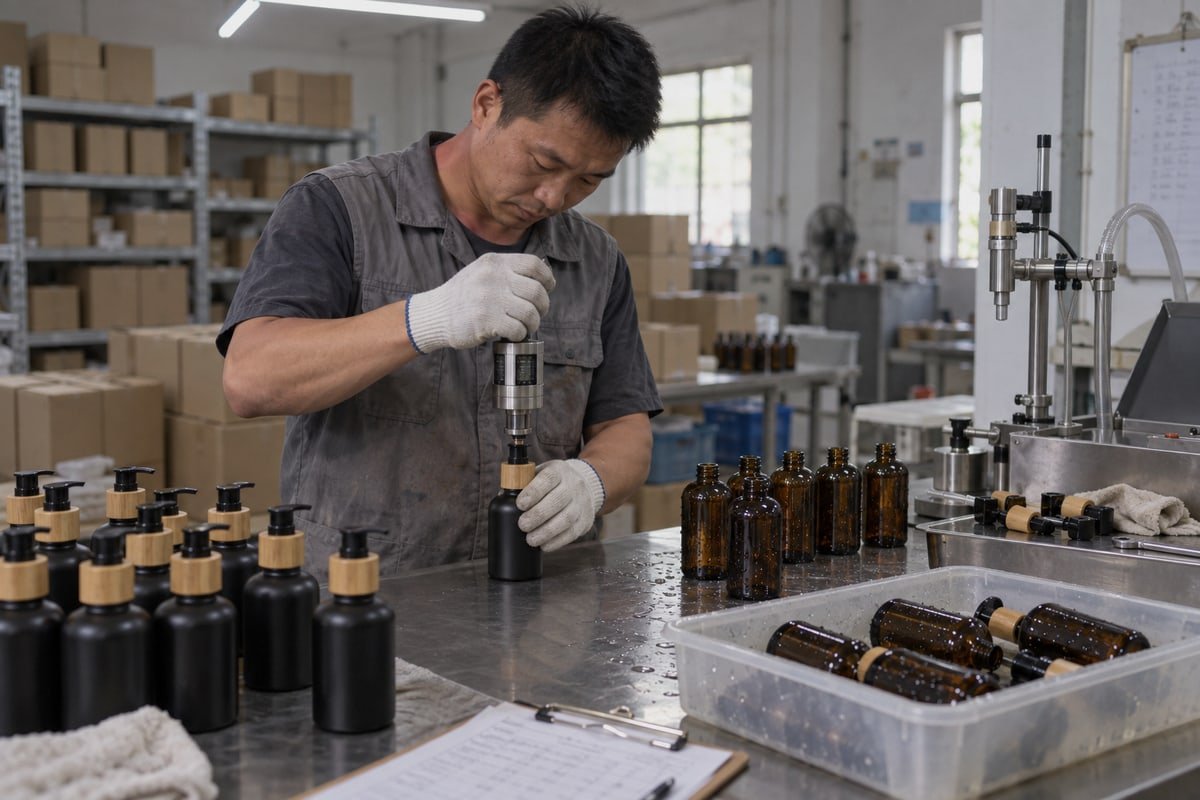
PET bottle samples that “look perfect” still jam filling lines. I’ve watched buyers approve containers from photos, then face leaking shipments, capping failures, and costly returns weeks later at our Taizhou facility.
Tests that confirm PET bottle samples fit your filling line include dimensional verification, neck finish measurement, capping torque checks, fill-volume calibration, leak testing under real conditions, top load strength testing, and a pilot run on your actual equipment with your real product formula.
A bottle is only approved when it works as a complete package. That means your closure, your product, your temperature, and your machines. Let me walk you through each test that proves it.
What tests confirm my PET bottle samples won't leak during filling and shipping?
A procurement manager in Australia once told me her biggest fear was opening a container of returned stock. Leaks had ruined an entire retail launch. That conversation still shapes how we test every sample.
Leak-proof confirmation requires inverted and side-storage leak tests, capping torque verification, seal integrity checks with the actual liner, fill-volume testing to the correct headspace, and stress crack resistance testing—all performed with your real product formula, not just water.
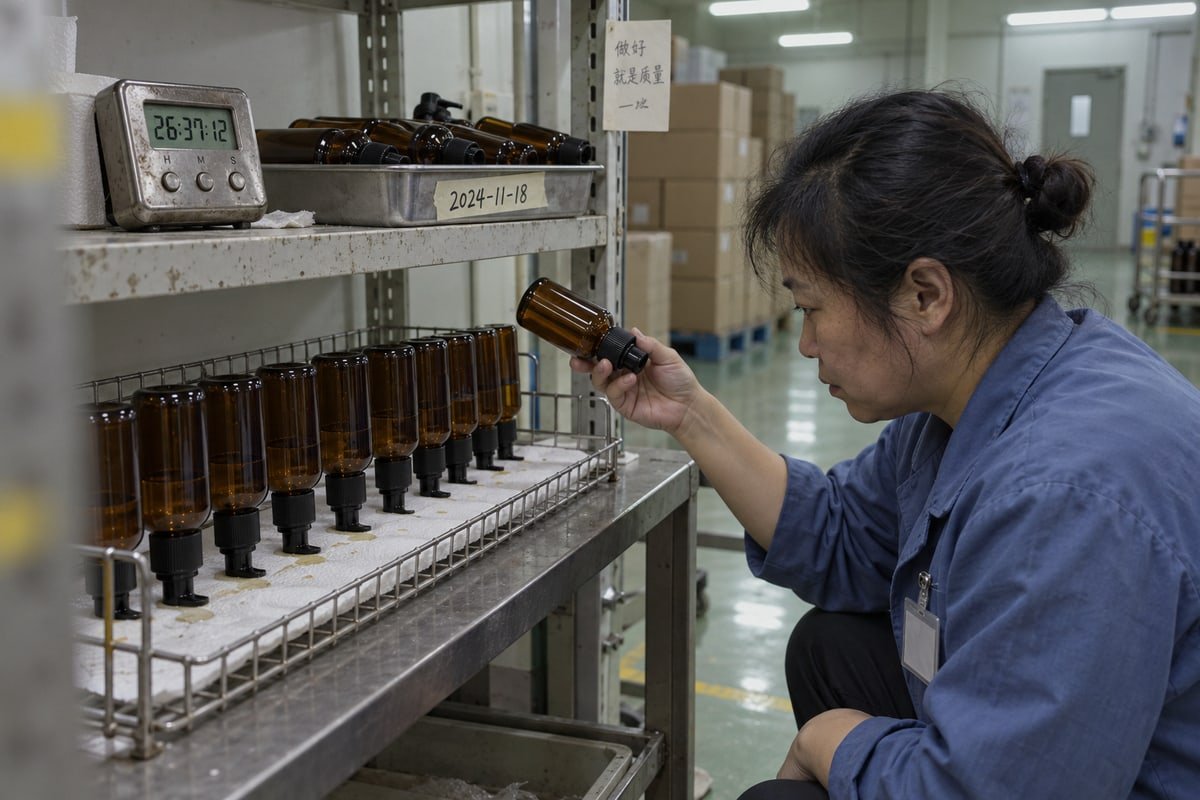
Leaks rarely show up when a bottle sits upright on a desk. They show up in a shipping container, on its side, under pressure, after temperature swings. So your testing has to recreate those conditions before you approve anything.
The core leak-prevention test set
Start with the physical seal. The closure must apply smoothly and hold within a usable torque range. We measure removal torque 1 after filling and cooling, because torque relaxes as PET and the liner settle. A cap that felt tight at capping can loosen hours later.
Then test orientation. Fill samples to the intended level, cap them at production torque, and store them inverted and on their sides for several days. Upright storage misses slow seepage along the threads. Inverted storage exposes it fast.
| Test | What It Catches | How To Run It |
|---|---|---|
| Inverted leak test | Thread seepage, liner gaps | Fill, cap, invert 24–72 hours |
| Side-storage test | Slow seal failure in transit position | Store filled bottles horizontally |
| Removal torque check | Loose caps, back-off after cooling | Measure torque after fill and cool-down |
| Fill-volume / brimful check | Overfill spillage, wrong headspace | Verify actual volume at the fill line |
| Stress crack resistance | Cracking from formula or rPET impurities | Expose filled bottles to stress conditions |
Why water-fill testing is not enough
Many buyers assume a water test settles the question. It does not. Water catches obvious leaks, but it misses formula-specific failures. Oils can swell certain liners. Acidic or solvent-like formulas can trigger stress cracking in PET, especially in rPET blends 2 where material impurities lower long-term stability. Viscous serums behave differently at the seal land than water ever will. For our cosmetic clients, we always insist on a formula-filled evaluation before sign-off.
For induction-sealed packages, record everything together: bottle material, neck finish, sealing-land dimensions, liner grade, filling temperature, and the time between capping and sealing. If one variable changes, the seal result changes.
How do I check if my PET bottle samples match my filling line's speed and equipment settings?
When we develop custom bottles for high-speed lines, the trade-off we weigh most often is weight versus stability. A lighter bottle saves cost, but shave too much and it wobbles on the conveyor at speed.
Match samples to your line by verifying neck finish dimensions against your capping head, checking perpendicularity and verticality for conveyor stability, mapping wall thickness distribution, testing coefficient of friction on the surface, and confirming the bottle mouth suits your filling nozzles.
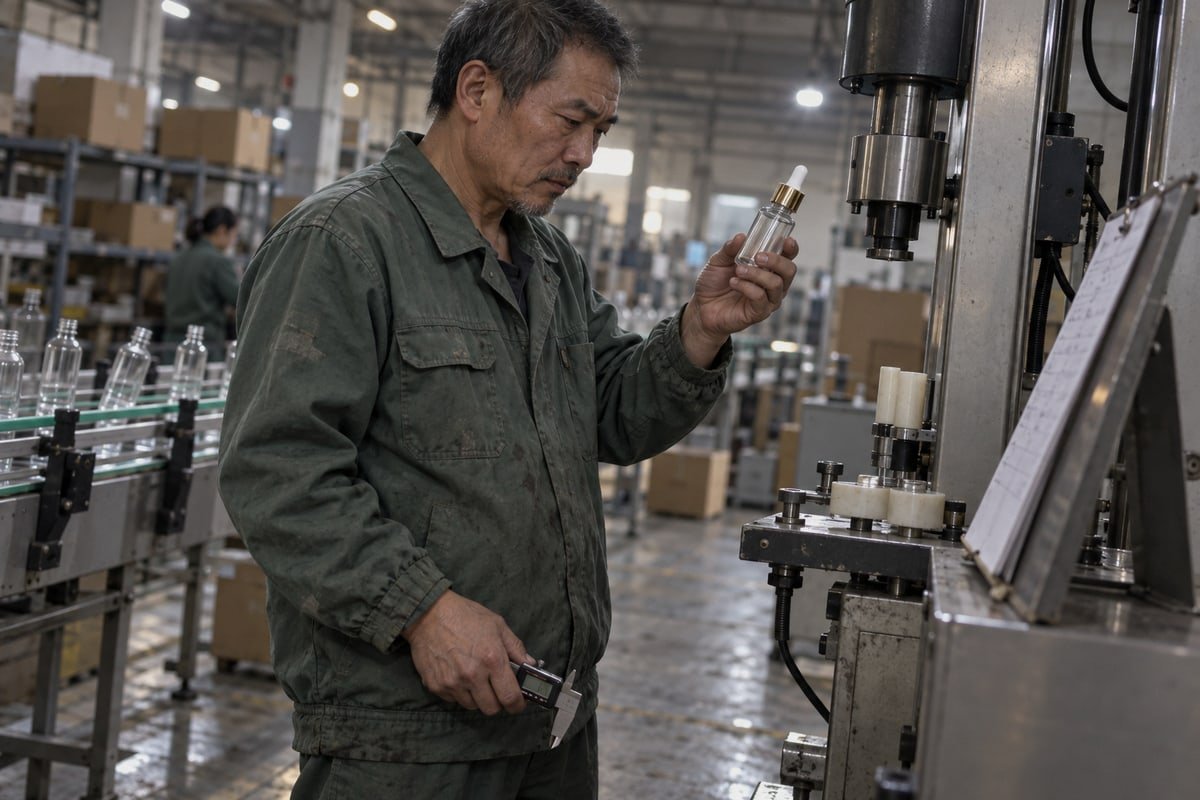
Line compatibility starts with geometry. The standard neck finish dimensions 3—the E, T, I, and H measurements—must match your capping and sealing equipment exactly. A fraction of a millimeter off on the thread diameter, and your capper cross-threads or under-torques. Check the bottle drawing against physical samples, and check both against your closure specification.
The geometry checks that keep lines running
Perpendicularity and verticality matter more than most buyers realize. A bottle that leans slightly will tilt on high-speed conveyors, causing misfeeds, spills, or damage to filling valves. Dimensional stability across the whole sample lot matters just as much. One good sample means little if the next hundred vary.
Wall thickness distribution is the hidden factor. Uneven material distribution creates thin spots that buckle under filler pressure or cool unevenly. We map thickness at the shoulder, sidewall, and base on every pre-production sample, because a bottle can meet its weight spec while still having a weak zone.
Surface and sensor compatibility
Two checks get skipped constantly. First, coefficient of friction on the external surface. Bottles with the wrong surface finish "shingle" or block in air conveyors and accumulation tables. Second, optical clarity and haze. If your line uses infrared fill-level sensors or vision inspection, excess haze in the PET can cause false rejects.
| Line Component | Bottle Property To Verify |
|---|---|
| Capping head | Neck finish E, T, I, H dimensions; capping torque range |
| Filling nozzle | Mouth inner diameter, neck opening geometry |
| Conveyors and star wheels | Perpendicularity, base stability, body diameter |
| Air conveyors | Neck support ring, coefficient of friction |
| Fill-level sensors | Optical clarity, haze index |
| Labeler | Panel flatness, dimensional stability |
For complex custom shapes, some larger operations now run digital twin simulation 4 and FEA before cutting a mold, predicting how the geometry interacts with star-wheel and guide-rail configurations. It is a useful screen, but it supplements physical trials—it never replaces them.
What QC tests should I request before approving bulk production of my custom bottles?
Our QC team learned an expensive lesson early on: a single final inspection catches problems too late. A defect found at the end of a run means the whole run is at risk. Now we build multiple gates into every custom order.
Request dimensional verification, neck finish gauging, wall thickness mapping, top load strength testing, burst pressure testing for pressurized products, drop testing, capping torque validation, formula compatibility trials, and a documented multi-gate QC plan including first-off inspection, hourly sampling, and lab testing.

Think of QC in three layers: mechanical, process, and documentation. Each layer answers a different question, and skipping any one of them leaves a blind spot in your approval.
Mechanical durability tests
Top load strength testing confirms the bottle survives vertical crush forces during capping, palletizing, and stacking. This matters even for cosmetic bottles that never see carbonation, because pallets stack high in a shipping container. Drop testing checks survival from filling-line height and warehouse handling. For products with carbonation or nitrogen dosing, add internal burst pressure testing to confirm the container holds without deformation.
Thermal checks belong here too. If your product fills warm, verify thermal stability at the actual filling temperature, and confirm the PET grade's heat-resistance rating matches your process. Hot-fill applications also need vacuum resistance testing, because bottle walls can panel or collapse as the product cools and the internal pressure drops.
Process gates, not one final check
A robust plan uses three gates rather than one:
- First-off inspection when production starts, checking dimensions, weight, and defects against the approved sample.
- Hourly sample QC during the run, catching drift in material distribution or color before it spreads.
- Lab testing on retained samples for torque, top load, and leak performance.
The approval record
Your sign-off document should specify, at minimum:
| Item To Document | Why It Matters |
|---|---|
| Material grade and resin (including rPET percentage) | Affects stress crack resistance and clarity |
| Full dimensional drawing with tolerances | Basis for every future dispute |
| Weight with tolerance | Controls material distribution consistency |
| Color reference and decoration standard | Prevents batch-to-batch drift |
| Closure fit and torque range | Defines the acceptable capping window |
| Defect limits (AQL levels) | Sets pass/fail rules for inspection |
| Packing method | Protects bottles in transit to your line |
At our factory, buyers who request this documentation up front almost never face disputes later. The record is what turns a "good sample" into an enforceable production standard.
Can sample testing help me avoid delays and returns once I place my full order?
A buyer in Germany once shipped us photos of pallets deformed in transit—bottles from another supplier that had never been top-load tested. The rework cost more than the original order. That is the exact scenario proper sample testing exists to prevent.
Yes. Thorough sample testing prevents the most expensive failures: leaking shipments, capping rejects, line downtime, customer returns, and rework. A pilot run on your actual filling line, using production-representative samples and your real formula, catches problems while they still cost samples—not containers.

The economics are simple. A failed sample costs you days. A failed bulk order costs you months, plus freight, plus your retail launch window. Every delay and return traces back to a test that was skipped or shortcut.
The pilot run: your final decision gate
Lab tests are valuable, but they cannot replace a trial on your real machinery. Run a small batch through your actual filling and capping equipment and watch for:
- Bottles feeding smoothly through conveyors and star wheels without tipping
- Filling nozzles entering the bottle mouth cleanly at line speed
- Cappers applying closures within the target capping torque window
- No deformation at the filler, capper, or labeler
- Reject rates and the reason for every reject
- Consistent seal quality across the whole trial batch
Record everything: bottle lot, cap lot, filling temperature, torque settings, machine speeds. Traceability is what lets you diagnose a failure instead of guessing at it.
A practical sample sequence
We guide our clients through a staged sequence rather than one giant leap: a stock reference sample first, then a bottle-and-closure matching sample, then custom-color and decorated samples, then a formula-filled evaluation, and finally a production-representative sample for the line trial. Each stage removes one category of risk before you spend money on the next.
The simple approval rule
Here is the rule I give every procurement manager: if the sample has not passed dimensional fit, closure fit, filled-package leak testing, and a real-line pilot run, it is not approved yet. No exceptions for deadlines. A one-week delay at the sample stage is always cheaper than a returned container. For our clients shipping DDP to Australia, the US, and Germany, this rule has been the single biggest protector of launch dates.
Conclusion
Approving a PET bottle from looks alone invites leaks, downtime, and returns. Test dimensions, torque, seals, and durability—then prove it all on your real line before ordering.
Footnotes
1. ISO provides international standards for testing the mechanical performance and closure integrity of plastic containers. ↩︎
2. The FDA regulates the safety and quality of recycled plastics used in food and cosmetic packaging. ↩︎
3. Wikipedia provides an overview of industry-standard packaging components and common measurement terminology for container closures. ↩︎
4. IEEE publishes technical standards and research on digital twin applications for optimizing industrial manufacturing processes. ↩︎
