

A supplier’s MOQ for PET bottles 1 that dwarfs your launch volume is a real headache. Our Taizhou production team hears it weekly. Cash locks up, and launches stall.
To handle a supplier’s MOQ for PET bottles that exceeds your needs, first convert the MOQ into months of demand, then negotiate levers such as higher unit price, standard molds, or split shipments, and switch to distributors or stock bottles if the gap remains too wide.
The rest of this guide walks through each step. I will show you how to negotiate, what to do when negotiation fails, how to run the math, and how to spot a supplier who will actually flex.
How can I negotiate a lower MOQ with my PET bottle supplier?
Last quarter a procurement manager in Melbourne asked us to drop the MOQ on a 200ml PET toner bottle. Her forecast covered a fraction of our standard run.
You can negotiate a lower MOQ with your PET bottle supplier by asking what drives the minimum, then trading something back: a higher unit price, paid setup or changeover fees, stock colors and closures, a blanket order with split shipments, or a phased volume commitment.

The Melbourne buyer got her smaller run. She did not get it by asking for a favor. She got it by making the small run cheap enough for us to say yes. That is the whole trick. A supplier's MOQ for PET bottles is a cost line, not a wall. If you lower the supplier's cost or raise their revenue, the number moves.
Start by asking what drives the MOQ
Before you make any offer, ask one plain question: "What sets this MOQ?" The answer changes your strategy. On our line, the minimum usually comes from one of four places. Line changeover time and color purging is the first. Resin, closure, or carton batch sizes is the second. Custom mold amortization is the third. The fourth is simply a commercial threshold we set to keep small orders from crowding out large ones. Each driver has a different fix.
| MOQ driver | What the supplier is protecting | The trade that works |
|---|---|---|
| Changeover and purging | Machine hours lost between runs | Pay a setup or changeover fee separately |
| Material batch sizes | Resin, masterbatch, or closures bought in bulk | Use stock colors and standard closures |
| Custom mold cost | Tooling paid back per bottle | Pay tooling upfront or accept higher unit price 2 |
| Commercial threshold | Capacity reserved for big accounts | Sign a blanket order with split shipments |
Trade, do not beg
Suppliers will tell you high MOQs keep prices competitive. That is true. Lower volume costs us more per bottle. So do not fight that point. Accept it and price it. Offer a higher unit price for the first run. Offer to cover the changeover fee. Ask for volume discount tiers that kick in on the second and third orders. That gives us a reason to invest in your growth.
Split shipment agreements are the compromise we sign most often. You commit to the full MOQ on a blanket order. We produce it and ship it in batches over six to twelve months. Your cash flow management improves. Our line runs efficiently. Both sides win.
A short script that works
Keep your message specific. Something like: "Our 180-day forecast is 6,000 units. Your MOQ is 20,000. We can move to your stock amber color and standard pump, pay the changeover fee, and sign a 12-month blanket order shipped in three lots. Can you support that?" That message gives me numbers, levers, and a commitment. It gets a real answer within a day.
What options do I have if I can't meet the minimum order quantity?
There is a trade-off we weigh on our line constantly: run a small batch and eat the changeover cost, or hold the MOQ and lose a promising buyer.
If you cannot meet the minimum order quantity, buy from wholesale packaging distributors, switch to off-the-shelf stock bottles, piggyback on a co-packer's inventory, ask about production overruns or off-spec rPET lots, join group buying, run a paid trial batch, or use inventory financing.
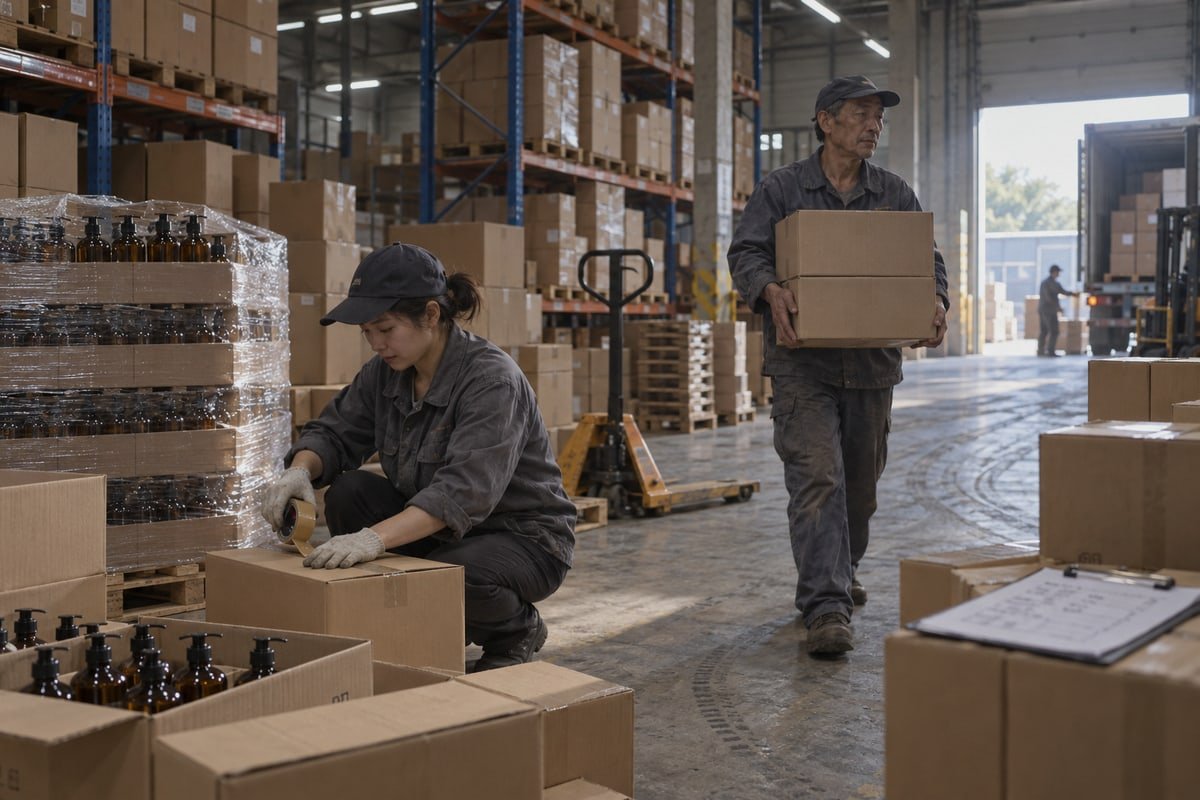
Sometimes negotiation stalls. The factory cannot go lower, and your demand cannot go higher. That is not the end. I tell buyers in that spot to look at the problem from three angles. You can change where you buy. You can change what you buy. Or you can change how you pay.
Change where you buy
Wholesale packaging distributors exist for this exact gap. They buy factory-sized lots and break them into smaller cases. You pay more per bottle. In return you can order a few hundred units and ship within days. Packaging sourcing agents do something similar for custom work. They pool requests from several small brands 3 and place one larger order with a factory like ours. Group buying cooperatives in the beauty and supplement space work the same way, just more informally.
A co-packer is another route. If your filler already runs a specific PET bottle for other clients, you can piggyback on their inventory. The bottle is proven on their line. That also cuts leakage risk, which is the complaint we hear most from Australian buyers.
Change what you buy
Off-the-shelf packaging is the fastest fix. A stock PET bottle with a standard 24/410 pump has almost no changeover. Ask your supplier for production overruns or cancelled orders too. Every factory holds a few pallets it would rather move than store. Off-spec rPET lots are another option. Slight color drift in recycled PET 4 makes them hard to sell as first-grade stock, so MOQs on those lots are often waived. For a natural or eco-positioned brand, that drift can even fit the story.
For a brand that truly needs a unique shape, bridge tooling is worth a look. Aluminum or printed molds produce small batches for market testing. You validate demand before committing to full production tooling and its 20,000-plus MOQ.
Change how you pay
Inventory financing and supply chain fintech let you fund the large upfront MOQ without draining working capital. This makes sense when the unit price gap is large and the product is proven. It makes less sense for an untested launch, because financing does not remove obsolescence risk. It only delays the cash hit.
| Option | Typical order size | Unit cost | Speed | Customization |
|---|---|---|---|---|
| Wholesale distributor | Hundreds | High | Days | Labels only |
| Stock bottle from factory | 500 to 2,000 | Medium | Weeks | Color, print, closure |
| Co-packer piggyback | Flexible | Medium | Fast | Limited |
| Overruns or off-spec rPET | Whatever is on hand | Low | Fast | None |
| Bridge tooling | Small batches | Very high | Weeks | Full shape |
| Financed full MOQ | 5,000 to 20,000+ | Lowest | Standard | Full |
How do I calculate the right MOQ for my brand's actual needs?
One lesson our QC team learned the hard way: bottles that sit eighteen months in a humid warehouse arrive at filling with scuffed shoulders and yellowed closures.
Calculate the right MOQ for your brand by dividing the supplier's MOQ by your monthly sales to get months of supply, then adding lead time buffer, inventory carrying costs, and obsolescence risk; if the result exceeds four to six months for an unproven product, the MOQ is too high.
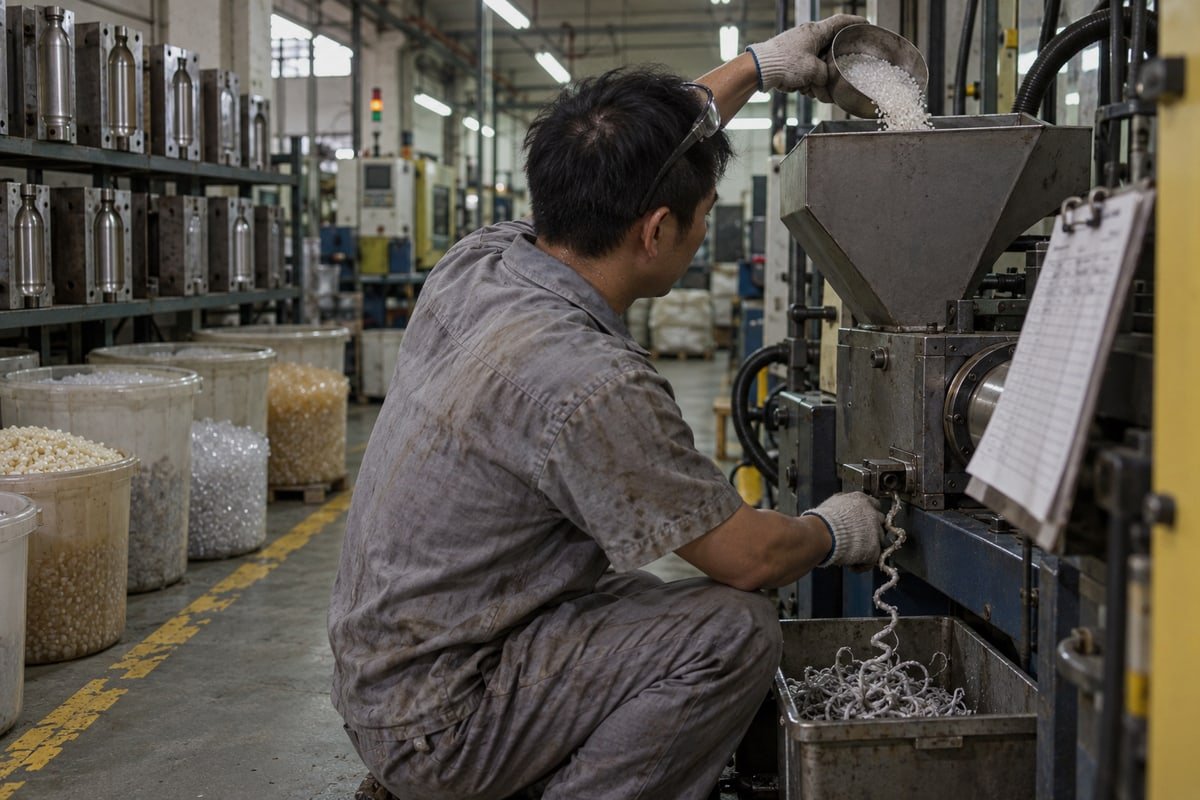
Buyers often compare MOQs on unit price alone. That is the mistake that fills warehouses. The cheap bottle is only cheap if you sell it before it costs you more in storage than you saved. So I ask buyers to run the numbers below before they push back on any supplier's MOQ for PET bottles.
The five-step calculation
- Estimate monthly demand. Use real sales velocity if you have it. For a launch, use your most conservative forecast, not your marketing target.
- Convert MOQ to months of supply. Divide the MOQ by monthly demand. A 20,000-unit MOQ at 2,000 units a month is ten months of stock.
- Add supply chain lead times. Our PET runs to Australia or Germany can take several weeks from production to DDP delivery. You need a buffer for that, so some stock is healthy. The question is how much.
- Add inventory carrying costs. Warehouse rent, handling, insurance, damage, and shrinkage all count. Then add the cost of cash tied up that could fund marketing instead.
- Set your maximum stock risk. Decide the highest inventory value you can hold if the product sells at half your forecast. That number is your true ceiling.
A worked example
Say a startup launches a PET serum bottle. The supplier offers two prices.
| Scenario | MOQ | Unit price | Monthly demand | Months of supply | Risk verdict |
|---|---|---|---|---|---|
| Full custom run | 20,000 | Low | 2,000 | 10 | Too high for a new product |
| Negotiated stock bottle | 5,000 | Higher | 2,000 | 2.5 | Comfortable |
| Blanket order, four lots | 20,000 total, 5,000 per lot | Low | 2,000 | 2.5 per lot | Comfortable if commitment is safe |
The full custom run looks cheapest on paper. It also parks ten months of stock. If the launch underperforms, you own bottles you will never fill. The blanket order keeps the low price while capping exposure per lot. That is why we push it so often.
Rolling forecasts beat one-time guesses
Keep a rolling 90 to 180 day forecast and share it with your supplier. Brands that do this get better terms from us. We can plan resin buys and line time around a forecast. We cannot plan around a vague request for "a smaller order."
Can I find a supplier who offers flexible MOQ for custom PET bottles?
When we set up custom blow molding for a new PET serum bottle, the first stretch of output goes to purging and calibration before a single sellable bottle drops.
Yes, suppliers offering flexible MOQ for custom PET bottles exist, usually factories that own stock molds and add custom colors, printing, or closures; expect 500 to 2,000 units for stock designs, 5,000 to 10,000 for standard runs, and 20,000 or more for fully custom molds.
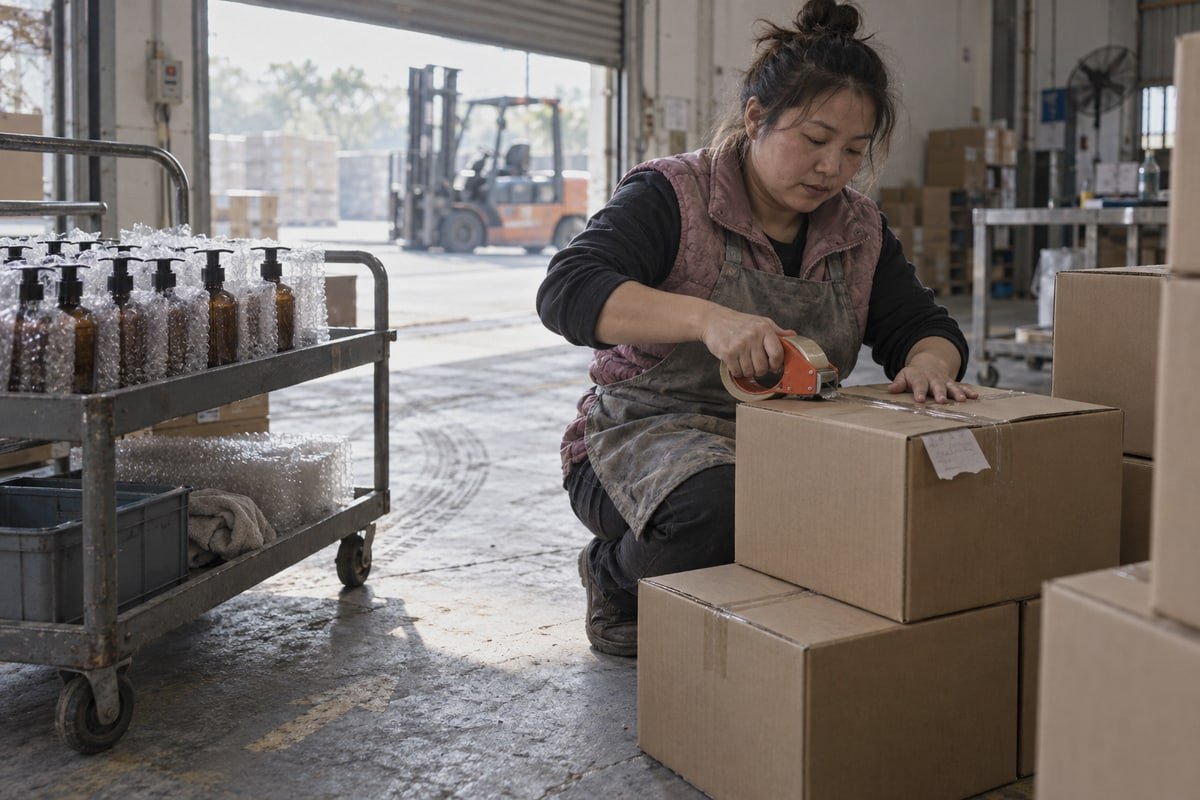
That purge-and-calibrate stage is why flexibility has limits. Rigid plastic manufacturing punishes short runs. Preform production, heating, stretch blow molding, and cooling all run best at steady state. A factory can absorb that inefficiency for small buyers, but only if the rest of the order is simple. So the flexible supplier you are looking for is not a magician. It is a factory with a deep stock mold library and a clear menu of what it will customize on top.
What "flexible MOQ" really means
Flexibility usually comes in layers. The bottle shape stays stock. The color, decoration, and closure become custom. This is how we run our own cosmetic packaging line in Taizhou. Our stock PET lotion and toner shapes share standard neck finishes with our glass pump bottles, so the same bamboo or black pump collars fit both. That shared component pool is what lets us quote a lower MOQ on a "custom" bottle. The customer sees a branded product. Our line sees a familiar mold with a color change.
| Layer of customization | Effect on MOQ | Effect on lead time |
|---|---|---|
| Stock shape, stock color, stock closure | Lowest | Shortest |
| Stock shape, custom color or print | Moderate increase | Adds color matching and proof approval |
| Stock shape, custom closure or decoration | Moderate increase | Depends on closure supplier |
| Fully custom mold | Highest, often 20,000+ | Adds tooling weeks plus sampling |
Questions that reveal a truly flexible supplier
Ask how many stock PET molds they own and whether you can sample them. Ask whether their MOQ applies per bottle, per color, per closure, or per order value. Ask if they will hold finished stock for split shipment agreements. Ask about their QC process for leak testing on pump and dropper assemblies, because a small run is worthless if it leaks in transit. And ask about supply chain lead times 5 to your specific port under DDP terms. A supplier who answers all five clearly is one you can work with long term.
A fair warning about the trade-off
Buyers sometimes hope for low MOQ, low price, short lead time, and full customization all at once. That combination does not exist in blow molding. Lower MOQ usually means higher unit cost, longer lead time, or less customization. Choose the two that matter most for your launch, and let the third flex. A supplier who promises all four is either hiding fees or planning to disappoint you on delivery.
Conclusion
A supplier's MOQ for PET bottles is a math problem first. Measure months of supply, trade specific levers, and keep a fallback source. Message us; we will run the numbers.
Footnotes
1. ISO provides international standards for plastic manufacturing and packaging quality. ↩︎
2. Statista offers global market data and statistics on manufacturing and industrial costs. ↩︎
3. Trade.gov provides resources and support for small brands entering international markets. ↩︎
4. The EPA provides guidelines and information on plastic recycling and material sustainability. ↩︎
5. The WCO provides global standards and resources for international supply chain and logistics. ↩︎
